Amazon

Wednesday, January 16, 2013

SPX and Euro: Euro Ready for a Correction


In yesterday's update, the preferred short-term count expected the S&P 500 to decline to 1461 +/-, then reverse to new highs.  The market found a bottom two points shy, at 1463, then moved up to make a very marginal new high.  Normally, we'd now expect a standard five-wave impulsive rally to unfold over the near-term, but I've outlined a second potential path because the option's still open, and I have a suspicion about what the market may be planning here for the short-term.  Targets for the two most-likely near-term paths, and levels to watch to differentiate the two, are listed on the chart below.


Note that both short-term counts presently expect this move to resolve higher, this is simply an option to be aware of, because expanded flats (the green path outlined above) often get traders on the wrong footing, since they almost always kick out the last swing low before reversing higher -- in other words, they behave just like the move I predicted yesterday.  This is basically a larger fractal of the same type of structure.

The hourly SPX chart is shown below, and there's nothing in the charts yet to suggest that November/December's upside target zone won't be reached -- though the market has now come within 7 points, and sometimes "within a few points" is as good as it gets in this business, especially for long-standing targets.


The main thing bothering me right now for equities has nothing to do with the equities charts:  I've been trading the euro/US dollar currency pair all night, and I suspect euro is on the verge of a steep decline toward 1.312-1.314 in the next few sessions.  Although there's no guarantee this will impact equities, it's a factor to remain alert to.

Below is a chart of the FXE currency shares euro trust.  While the numbers here vary slightly from the actual Forex market, the wave count is the same.  The retrace target is listed using the actual Forex rates -- if the most recent rally was all of wave (5), then an even deeper correction will ensue.

NOTE:  Intraday real-time adjustment on Euro -- I reworked my micro count in Euro/USD and it is entirely possible that an ABC completed at last night's low.  It all comes down to key support now: as long as 1.32559 holds as support, it may move to new highs from here... and bears probably don't want to see it back above 1.33471 at this point, or it could easily go back into launch mode.  Below 1.32559 and the target becomes active.

(continued, next page)

Tuesday, January 15, 2013

Time for Caution, Though No Reason to Be Bearish Yet


The updates have been suggesting higher prices all month, and the waves are still pointed upwards for the moment -- but I do want to show a few charts that act as caveats and suggest some degree of caution is in order.  The equities markets have remained a bit fractured, in the sense that related markets often seem to be suggesting completely different things -- and this is still making it difficult to predict exactly where we are in the larger picture.  I continue to lean bullish, but a little caution is now in order.

To illustrate the fractured nature of things: the S&P 500 (SPX) is suggesting a smallish correction that holds above 1451, then on to new highs.  But the NYSE Composite and Philadelphia Bank Index (BKX) are hinting that a larger correction may ensue.  There's simply no way to know for sure which it will be at this phase: we're too close to the recent highs to project much to the downside. 

Let's start with the short-term SPX chart.  This chart shows what is almost-certainly a three-wave rally into the 1472 print high, which suggests an expanded flat is unfolding (or already complete).  The expanded flat seems to connect the rally from 1451 to the wave that is unfolding now, which suggests the first part of the rally is simply wave (1) of (5) of the larger wave 3.

Note that the corrective fractal could be complete at the red wave A/alt: (4) label, in which case higher prices are due directly; this appears less likely, but trade beneath 1465.69 is required to confirm the 1461 target.  The only way to eliminate the bullish (1)/(2) potential of this chart is for the market to break below 1451.  Compounding the issue is the fact that the waveform from 1451 is exceptionally weird.


Moving out to the 30-minute SPX chart, we see how this wave fits into the bigger picture (labeled as red (i) (ii) and (iii) on this chart).  Note the alternate count that ALL OF wave 3 has completed.


There are no meaningful signs of a turn yet, but both NYA and the Philadelphia Bank Index (BKX) are sporting the potential of complete rallies.  The challenge here, though, is that the same structure discussed in SPX is entirely possible, and the wave labeled as "v?" may only be wave (1) of v.  There's simply no way to tell this early, but I would be remiss not to warn. (continued, next page)

Monday, January 14, 2013

A Survival Guide for Bears in a Bull's World


Ah, it's open season here my friend.
It always is; it always has been.
Welcome, welcome to the U.S.A.
We're partying fools in the autumn of our heyday.


And though we're running out of everything,
we can't afford to quit.
Before this binge is over,
we've got to squeeze off one more hit:
We're workin' it.

.....

We got the short-term gain, the long-term mess,
we got the suffocating, quarterly consciousness.
(Yes man, run like a thief.)

New York to Hollywood, hype and glory,
special effects, but no story.
(Yes man, run like a thief.)


- Don Henley, Working It

There's been no material change in the market outlook, so today I'm going to focus on discussing the world's fundamental debt problems, and how those problems may impact investor psychology.

Let's imagine you found yourself in an H.G. Wells novel, and used his famous machine to time-travel into the future to a random, unknown year.  As fate would have it, you just happen to land in the exact year when there's a worldwide financial meltdown -- but before you can find out what year it actually is, your time-machine whisks you back to the present, and then ceases functioning.

You are now in possession of powerful, and somewhat frightening, information.  You know this financial meltdown will happen at some point in the future, but the problem is: you don't know when.  It could be in two weeks, it could be in two decades.

You are an investor and a trader, so suddenly you look at the market and wonder:  "What if this future I experienced happens tomorrow?"  You react emotionally, rightfully worried, and you immediately pull all of your investments out of the market.  Then the market starts going up, and you wonder again:  "Hmm.  What if this future happens many, many years from now and I miss out on everything in-between?"  You have powerful knowledge of the future -- but how can you profit from knowing something will happen, if you have no actual time frame for knowing when it will happen?

I use this analogy because I think many bears have fallen into a very similar trap for years.  Bears tend to be smart, free-thinking individuals, who are a bit contrarian in nature.  This feeling of being contrarian isn't really by choice; it comes from the fact that bullishness is packaged as the "American Way," and the mainstream media often mocks bears openly with a variety of semi-demeaning nicknames.  These names run a wide gamut, from Nouriel Roubini's media-dubbed nickname of "Doctor Doom" all the way to Peter Schiff's media-dubbed nickname of -- you guessed it -- "Doctor Doom" (nobody ever accused the media of being creative).  The mainstream media's propensity to nickname anyone who's bearish as "Doctor Doom" (also: "Professor Doom," "Mister Doom," "Cousin Doom," "Big Daddy Doom," etc.), understandably makes bears feel they are ostracized and outcasts.

The funny thing is: many bears started off as bulls, and then felt they had some type of catharsis -- some type of "informational awakening" -- which converted them into bears.

I had this fundamental conversion experience in the late 90's, and yet I have been very bullish on the market at several points since.  I'll explain why in a moment.  In my heart, I'm bearish on the fundamentals, because I believe the massive debt that the world has accumulated is completely unsustainable.  We have reached levels of public and private debt that are wholly unprecedented, to the point where the term "record levels" is an understatement.

According to the Bank for International Settlements, the debt of governments, private households, and non-financial companies rose from 160% of GDP in 1980, to 321% of GDP in 2010.  After the figures are adjusted for inflation, the world's governments have more than four times the debt levels of 1980, and private households have more than six times the debt.

(continued, next page)

Friday, January 11, 2013

The Pattern Repeats: Is It Really This Simple?


Last update noted that new highs were expected directly, and the market has obliged and now kicked out some key intermediate levels to the upside, suggesting the rally will continue.  There's really not much to add to the bullish expectations and projections of the last couple weeks-worth of updates, and the market continues to perform in line with my preferred bullish wave counts.  I'm anxious to see if my intermediate target of 1490 +/- from November will be reached on this leg, as it's something of a long wait between the time an intermediate projection is published and the time the market actually reaches it (or doesn't). 

There's still nothing in the charts that's screaming "sell!"  When looking at a long-term chart of the S&P 500 (SPX), we can see obvious similarities between the current pattern and the last two rallies.  While the market always reserves the right to create confusion or to have a pattern fail, the present pattern is quite bullish, and a trip into the mid-high 1500's would be an entirely reasonable result.


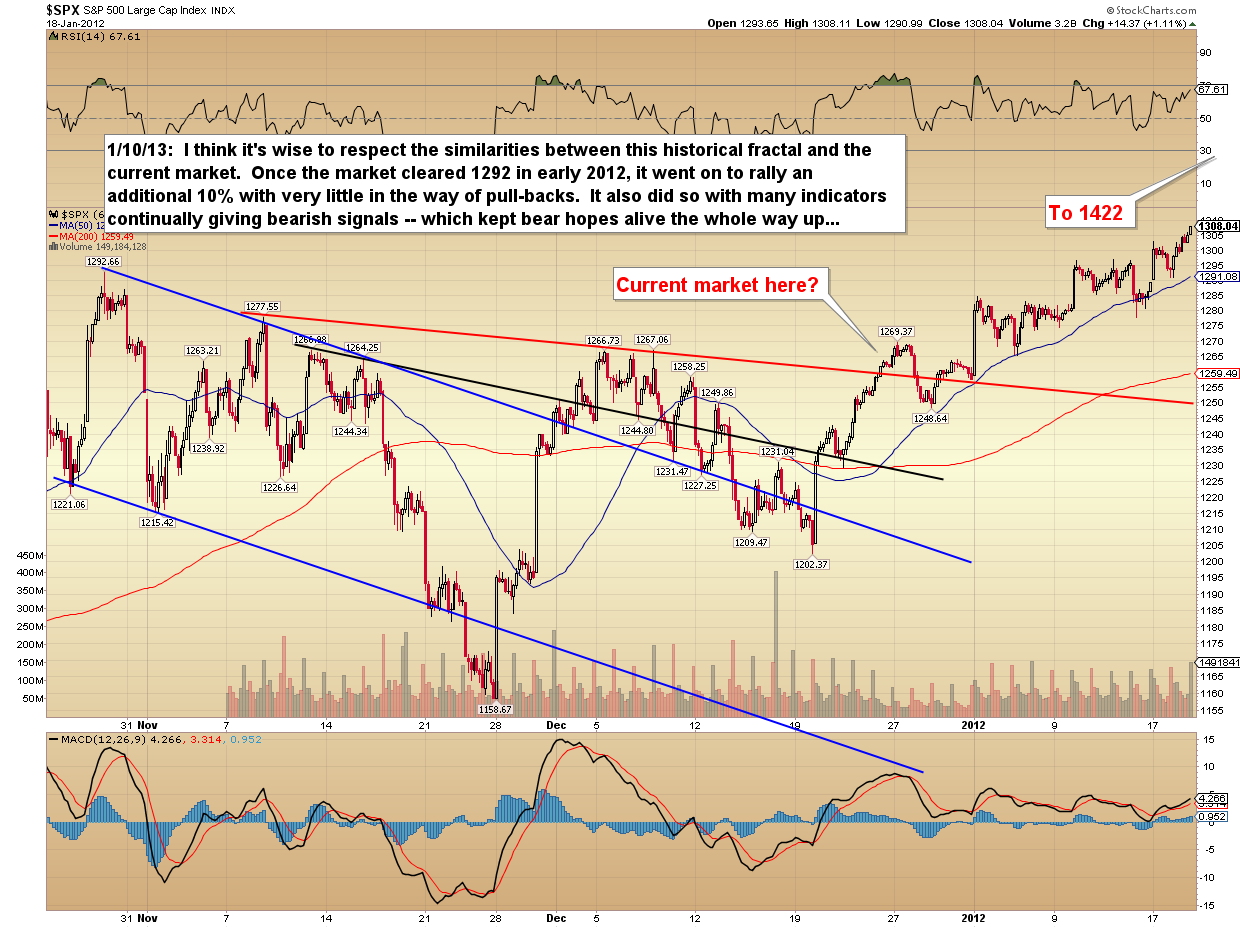
I'm also reprinting the zoomed-in December 2011 fractal, because I do think it's relevant.


The updated 30-minute SPX chart is shown below.  Assuming the recent rally off 1451 doesn't mutate into something more complex or unusual, it appears ready to move higher.
(continued, next page)

Thursday, January 10, 2013

Is the Rally a December 2011 Redux?


In yesterday's update, I noted that I believed the downward correction had ended at 1451, and expected higher prices directly.  The market headed up a few points yesterday, and continues to appear poised to reach new highs.  Due to the position of this wave in the big picture, it is quite possible that my short-term upside targets are too conservative, though a "standard" wave would be nearing a turn and deeper correction.  As I noted on January 2:

...this is not a rally I would look to short anytime soon.  There is massive pent-up energy in the charts, and nested third waves are not to be trifled with.  Third waves are the "point of recognition" for the masses, and tend to be strong trending waves that rarely let up for very long.  Third waves tend to peg indicators at extreme readings and stay there for much longer than seems reasonable.


I do want to briefly call attention to the similarities between the current wave and the intermediate bottom which formed in November/December 2011.  I recall that rally as being one which defied gravity, and which bears kept trying to short (myself included at times) -- and yet it ran on and on for months.  The present rally has similar hallmarks; the difference is the present rally falls in the third wave position at higher degree, and that suggests it should actually be faster and stronger than the previous wave.


In conclusion, there's little changed in the outlook of late.  So far, there are no indications of any kind of significant top.  Trade safe.

Reprinted by Permission; Copyright 2012, Minyanville Media, Inc.

Wednesday, January 9, 2013

SPX, NYA, RUT: Market Consolidates Recent Gains


Yesterday the market spent some time consolidating its recent gains.  So far, there's nothing to indicate this is anything other than a correction before the rally continues, though as discussed in prior updates, we should remain cognizant that several markets are approaching (or have reached) long-term resistance.  I’m trying to weigh that fact against the indications that this is a third wave rally -- and that means I'm unwilling to attempt to front-run a turn, and will wait for the market to lead in that regard.

To further illustrate that point, the first chart I'd like to share is the NYSE Composite (NYA) daily chart.  The long-term resistance zone is about the only thing bears have going for them here.  Since 2011, the NYA has done nothing but muscle through resistance level after resistance level.  As I've noted on many occasions since September 2012, there is just nothing bearish about this chart.  The mirroring shared between the last few months of the current rally and the first few months of the 2011 mini-crash is interesting.


Next, I'd like to update the Russell 2000 (RUT) chart, which I last published on December 19.  I noted then that I felt the pattern was intermediate bullish no matter how you sliced it, and RUT has now reached the lower edge of my previously-published target zone.  It does still appear to have farther to run, and I've outlined one potential path in blue.  I continue to believe RUT will act as a pretty decent litmus test for the rest of the market, and if it can claim the 902 level that's mentioned on the chart, it's going to be a bit more challenging to find much in the way of long-term bearish options for this pattern.


Finally, the update for the S&P 500 (SPX), which presently looks like it completed a small ABC to wrap-up red wave 4.  Back below 1451 would open up the potential of a deeper correction, with the first target being 1440-1445.

Again, there's presently nothing to be bearish about in this chart, and this simply isn't the type of wave where I'm eager to try and front-run a turn -- third waves can run on much longer than one thinks is reasonable.  If the market gives some signs of turning lower, and starts looking impulsive to the downside, then I'll discuss more bearish potentials. (continued, next page)

Tuesday, January 8, 2013

The Importance of the Market's Current Inflection Point


Friday's update noted that the market was approaching an inflection point, but expected that the S&P 500 (SPX) had at least one more fourth wave correction and fifth wave higher still to come, which the market fulfilled.  The short-term charts are in a bit of flux at the moment; so I'll discuss the short-term later, but want to focus on the long-term in this update.  In most recent updates, I've focused on the long-term bull potential, which I'm still favoring.  I should probably make it clear that I'm not suddenly flipping to the bear side here, but nevertheless, I do want to bring a bit more balance to that discussion.

I want to start off with a chart that does a reasonable job of highlighting the long-term importance of the current inflection point.  The Philadelphia Bank Index (BKX) has broken out and back-tested a bullish basing pattern, and is now in a critical long-term resistance inflection zone.

The problem for bears is that this chart simply isn't bearish -- it has bearish potential; but it's important to understand the difference. 


The chart below zooms in a bit on BKX and discusses the likely wave structures and targets.  While BKX has loved blow-off tops of late, I have to favor the more traditional market pattern, which is that the strongest waves usually fall closer to the middle of the pattern -- thus suggesting further upside is still out there after the next correction.


The Nasdaq 100 (NDX) also continues to highlight how critical the current zone is for bears to defend. (continued, next page)