Amazon

Showing posts sorted by date for query Is there a climate crisis. Sort by relevance Show all posts

Sunday, October 24, 2021

Is There a Climate "Crisis"? Part II: A Look at the Hard Evidence; Extreme Weather

[In Part I of this series, we examined the scientific literature and learned that the Arctic today is 2-4 C colder than it was a mere 6-12,000 years ago.]

To reiterate briefly from Part I:

"change" ≠ "crisis"

These are two very different words, with very different meanings.

"Change" means "to make or become different." 
"Crisis" means "a time of intense difficulty, trouble, or danger."

A few years back, all we heard was how there was a "consensus" on climate "change." But then politicians and the media gradually began to conflate the term "change" with the term "crisis," often by adding in their own commentary to "97% of scientists agree..." They would say things like, "97% of scientists agree the Earth is warming up and that if we don't do something immediate and drastic, then we're all going to perish in flames! Everyone RUN FOR YOUR LIVES!"

97% of scientists agreed to no such thing; but this verbal bait-and-switch has been done by politicians and media to the point that few seem to question it anymore.

Thus, [if one actually cares about what science has to say, anyway] it is extremely important to clarify that there is no consensus on a climate "crisis." There is a consensus on climate "change" (though one can strongly debate the methodology of the surveys used to determine that "consensus," and further debate whether consensus has any value in science in the first place -- but for sake of argument, let's grant that point for now anyway, because it's irrelevant), but it bears repeating that there is no consensus that this climate "change" represents any sort of "existential crisis" for the planet.


The idea that there's a "crisis" is held by a small minority of scientists, but, as this piece will show, that view is not shared by mainstream science.  

Please read that again if needed.  I'm not going to be citing "deniers" or fringe papers, I'm going to be citing mainstream organizations that are held to be the gold standard by even the most dyed-in-the-wool climate change believers.

If one accepts mainstream consensus science (which I am not necessarily condoning, mind you -- "consensus" is the business of politics, not science -- but that's a whole 'nother discussion), one will quickly see that climate "crisis" is a fringe position -- meaning: If one invokes consensus (thus implying that they accept mainstream science), then one must logically reject the idea that there's a crisis.

However, because the general public listens to the media more than they read scientific literature, many have accepted this fringe claim without question. So let's examine the claim, again using only mainstream science:

Claim:  Extreme weather events (such as hurricanes, tornadoes, floods, droughts, etc.) have increased; this is due to man-made climate change, which is caused by CO2 emissions

Made by:  Politicians, media, activists

Rejected by:  The Intergovernmental Panel on Climate Change (IPCC), The National Oceanic and Atmospheric Association (NOAA), The Environmental Protection Agency (EPA), most other mainstream scientists, and The Actual Hard Data

As we'll see in a moment, there is effectively zero basis for this claim.  This lie has been repeated so often that it "seems credible" to the point that it's become akin to an urban myth that "everyone knows" -- but we'll quickly see that mainstream science rejects this superstition.

The IPCC has done not one, but two "Special Report[s] on Extreme Weather," (in 2012 and 2018) to examine precisely this exact issue, so we'll start there.  

Before we get into that, though, it bears mention that many consider the IPCC to be too heavily biased toward blaming man/CO2 for climate change.  They have repeatedly pushed out scientists who dissent from the view that CO2 is a primary driver of climate.  Further, the IPCC's mandate is to find manmade climate change and to ignore natural explanations -- which leads to "when all you have is a hammer, everything looks like a nail" syndrome.  I consider them to be an alarmist organization, so when the IPCC says, "Nope, we're not seeing it," even given their heavy biases and incentive to find it... well, things don't get much stronger than that.

The full Reports (everything in blue is a live link -- some people in the comments seem to be missing this) are long reads (hundreds of pages each), which is why almost no one seems to know what's in them, so let's summarize via some screenshots of the summary highlights.

1. Floods

Here's what the IPCC says about global flood trends:  No sign that floods are increasing:


The U.S. National Climate Assessment (which examined only the USA) says there's a mixture of local increases and decreases, concluding that "approaches have not established a significant connection of increased riverine flooding to human-induced climate change":


2.  Drought

Here again, the IPCC sees no trend of increase in global droughts.  They even call out their own prior warnings as being "overstated."


This agrees with other mainstream scientific literature.  As one example:  Recently, we've been hearing a lot about California's drought -- few people realize that, to cite the paper below: 

"[S]ignificant drought conditions that were common prior to 1900 have not been experienced by the present population."

In other words, California isn't undergoing modern "climate change" as a result of your SUV -- it's merely reverting to its natural historic trends.


And both of these likewise agree with a study by Nature from a few years back.  Droughts appear to be decreasing, not increasing.


On this topic, let's take a brief moment to appreciate yet another failed negative climate prediction -- this one is from 33 years ago, and still going strong and dead wrong.  (If you saw this headline tomorrow, would it worry you?  You may be starting to realize why it shouldn't.)


3.  Hurricanes/cyclones

Here's what the IPCC says about hurricanes:  There has been a slight decrease in hurricane landfall numbers over the past century:


The IPCC's conclusion agrees with NOAA, who recently completed the largest hurricane study to date.  NOAA also finds no trend of increase -- to the contrary, they also find a slight negative trend since 1900:


The political nature of climate "science" is one the the reasons I take screenshots, such as the one above.  That study (as shown) was just done a year or so back, but they've already revised it (revised August 9 2021), and I'm not sure where the original is.  The new one still concludes:

Therefore, we conclude that it is premature to conclude with high confidence that increasing atmospheric greenhouse gas concentrations from human activities have had a detectable impact on Atlantic basin hurricane activity

So the conclusion is still the same -- no impact on hurricanes -- because the hard data is what it is, and the numbers simply aren't there (i.e.- there's been no actual increase in storms).  Nothing can make those missing storms appear, so what they do in the new report is couch those non-frightening bottom line conclusions with additional scary-sounding language warning about how awful it might get if the CO2 hypothesis ever starts working, since apparently 100+ years of data while CO2 rose steadily hasn't already proven the point that if hurricanes haven't increased yet, they're not likely to.  At least, not due to CO2, anyway.

According to World Bank, Big Climate is an $89 trillion (with a T) business, so there are plenty of vested interests with major monetary incentive to keep the public in a state of fear.  Hard to compete against that with simple hard data and mainstream science that no one reads.


Anyway, both of these newer reports continue to agree with the IPCC's findings from 2012:


These hurricane studies are pretty conclusive, with very little ambivalence.  If you've been getting your "science" from politicians and media, then I imagine it comes as a shock to learn the that mainstream scientific community does not support what you have been led to believe -- so your first reaction may be to look for ways to reject this "new" information and thus preserve those old beliefs ("cognitive dissonance").  I recommend giving this "new" data a little time to sink in.  

(And then reasoning out the inexorable conclusion:  It is a mistake to trust politicians and media simply because they invoke the mantle of "science."  Snake-oil salesmen of the 1800s likewise claimed that their false cures "followed the science."  It's one of the oldest con games in the book.  The media's take on climate change is more superstition than science, and politicians use the resulting public ignorance to their advantage, as we'll see in a moment.)


4.  Tornadoes

Strong tornadoes, likewise, are decreasing, not increasing:


To summarize:  The actual, mainstream science on all this is abundantly clear:  There is no link between "climate change" and extreme weather.  None whatsoever.  Next time someone in "authority" tries to claim there is, you will be inoculated against such manipulations.

"When you get two record rainfalls in a week, that's not coincidence." "Global warming is upon us, and it's going to get worse and worse and worse unless we do something about it." "Woe is us if we don't recognize these changes are due to climate change." -- Senator Chuck Schumer

“The past few days of Hurricane Ida and the wildfires in the west and the unprecedented flash floods in New York and New Jersey is yet another reminder that these extreme storms and the climate crisis are here."  "This isn't about politics." -- President Joe Biden

As the data plainly reveals:  Politics seems to be exactly what this is about.  Get people scared, then use their fear to generate public support for policies the public would not otherwise support if they were not being placed under duress.

Sadly, this unfettered manipulation by our politicians is not harmless.  It comes with real human cost:


Wouldn't it be better to tell our kids the truth: That there is no climate "crisis"?  Have we become so desperate in our pursuit of power that we've lost our humanity?

Oh, and those earlier quotes reminded me... let's talk about wildfires, too, since that's another anti-science stance the alarmists have taken, and it keeps getting repeated to the point that many people think it's true.  It is not.  

5.  Wildfires

This first graph comes from the USDA (and is the most recent I can find from that particular agency).  It shows that wildfires declined substantially while CO2 rose:


The continuation of that data (from the National Interagency Fire Center) is similar.  Wildfires have decreased, not increased:


Data on Amazon wildfires comes from the LA Times.  Correlation is not causation, but when there's not even a correlation, you have no case whatsoever.


Linking wildfires to climate change is, again, anti-science superstitious nonsense with no data to support it.

So you can follow the science, or you can follow the politicians/media.  But you cannot follow both, because they contradict each other.

Last point, because this is more anti-science propaganda I hear repeated ad infinitum:  

6.  Heat waves

Surely heat waves have been getting worse!  After all, the theory is that CO2 causes the atmosphere to retain more heat (again, this is the actual theory underpinning "climate change"), so heat waves must be getting worse.  Right?  Remember this summer?  RIGHT?

Well, not according to the EPA.  While heat waves will always be a part of life on planet Earth, in recent decades, heat waves have decreased significantly.  Despite the fact that CO2 has been rising steadily. 


Now, the funny thing about the chart above is that it's no longer on the EPA website (that I can find, anyway; glad I screenshotted it a few months ago) -- they recently changed their new graphs so that they begin in 1960!  Look at the full chart, and see if you can figure out why they'd make that change.  Below is what happens when you leave off the "inconvenient data":  You create a false impression that heat waves are increasing over time. 

Are they removing long-term data to serve "science"?  Or politics?


Misleading graphs aside, to reiterate one last time:  There is no correlation between "climate change" and extreme weather.  And there isn't a single shred of evidence to even modestly support such claims.  

All the alarmists have is the same thing they had back in 1988:  Unsubstantiated speculation that "bUt wEatheR is gOinG to gEt wOrSe!!!111!!!"  Speculation isn't evidence, and climate speculation has been dead wrong for 50 years running, while the hard evidence is clear.  The data continues to refute the speculation.

The bottom line is that the IPCC, NOAA, et al, have concluded that there's been
no increase in extreme weather at all, so there's zero basis for claiming that 
this nonexistent increase is "due to man-made climate change"!  

Thus, the entire push to blame extreme weather on "climate change" is complete nonsense.

Mankind has always believed it can control the weather via dancing, human sacrifice, or by other means.  I assume this is why this superstition was easy to revive:  It's hard-wired into us to think weather is some kind of "punishment for our sins."  In this case, our sin is merely finding ways to survive a harsh planet in some degree of safety.  We clearly do not believe we deserve even that small grace, so now we're trying to undo it.

Which brings us to the final point:  Climate-related deaths have plummeted over the past 100 years:


(above graph from Dr. Bjorn Lomborg)

This massive reduction in climate death is due to the safety that cheap and reliable energy provides for people.  Taking that away in favor of unreliable sources such as wind and solar won't "save" people, it will harm them.  (Just as wind and solar damage the natural environment, which I may cover in a future piece).  Isn't the goal to "save" the planet?  What does that even mean if it excludes saving your fellow humans?

Join me in saving the planet: Reject climate superstition and propaganda, and follow the science instead.  The choice is now yours.


Tuesday, February 16, 2021

Bonus Investigative Piece: Is There a Climate "Crisis"? An Examination of the Evidence, Part I: The Arctic

Lately we've been hearing ad nauseum from politicians that there's a climate "crisis," so the first thing we need to clarify is this:

"change" ≠ "crisis"

These are two very different words, with very different meanings.  

"Change" means "to make or become different."

"Crisis" means "a time of intense difficulty, trouble, or danger."

A few years back, all we heard was how there was a "consensus" on climate "change."  But then politicians and the media gradually began to conflate the term "change" with the term "crisis," often by adding their own (considerable) commentary after the phrase "97% of scientists agree..."

They would say things like, "97% of scientists agree the Earth is warming up and that if we don't do something immediate and drastic, then we're all going to perish in flames!  RUN FOR YOUR LIVES!"

97% of scientists agreed to no such thing; but this verbal bait-and-switch has been successfully executed by politicians and media so often that few seem to question it anymore.

Thus, it is extremely important to clarify that there is no consensus on a climate "crisis."  There is a consensus on climate "change" (though one can strongly debate the methodology of the surveys used to determine that "consensus," and further debate whether consensus has any value in science in the first place -- but for sake of argument, let's grant that point for now anyway, because it's irrelevant), but it bears repeating that there is no consensus that this climate "change" represents any sort of "existential crisis" for the planet.

The idea that there's a "crisis" is indeed held by a small minority of scientists, but the view is not shared by the mainstream.  So climate "crisis" is a fringe position -- but because the general public listens to the media more than they read scientific literature, many have accepted this fringe claim without question. 

So let's examine the claim.  Because there's so much data to unpack, I've decided to break our examination of the evidence into several parts.

Where shall we start?

Let's start with something that bears being emphasized:  

What I'm about to share is not controversial.  This is mainstream science.  Instead, the things you hear sensationalized on the news are frequently controversial, and often not mainstream science!

That alone requires a major paradigm shift for most people, so I advise stopping and thinking about what that means for a moment.  "News" is a business that exists to sell advertising.  If the news doesn't have something that grabs your attention, you will not watch or read, and ratings/circulation will fall.  "Hey, everything is fine," just doesn't grab your attention in the way that, for example, "WE'RE ALL GOING TO DIE TOMORROW!" might.

To start off, we'll begin with a common sensationalized claim that one hears frequently on the news:  

Claim:  "Thanks to CO2, the Arctic is warmer than ever before!"

First off, to know if that claim about the present has any veracity, we would need to know what happened in the past.  Obviously, we can't know if the present is "warmer" (or colder) than the past unless we have past data to compare.

So we'll start by examining the recent past ("recent" in geologic terms, not in human lifetime terms; though we'll examine that, too).  Earth is 4.5 billion years old, which means that if we calculate an average human lifespan of 80 years, then one "year" for Earth is equal to roughly 56 million human years.  If the Earth existed on human time, then a human day would be more than 154,000 years in geologic time.  Said another way: 10,000 years ago for Earth is the equivalent of about an hour and a half ago to a human  (i.e.: tens of thousands of years represent the extremely recent past in geological time).

So, with a better grasp of geologic time frames:  What does paleoclimatology tell us about the recent past?  Is the Arctic actually warmer than ever before? 

Well... the short answer is "no."  As it turns out, the scientific data suggests that the Arctic is colder today that it was even a mere ~6,000-12,000 years ago. 

Included below are screenshots of the relevant portions of many different scientific papers, with the sources shown in the screenshots, in case anyone wants to refer to the entirety of the papers.  This is mainstream scientific literature that anyone can look up (including, I might add, our own vaunted news organizations -- if they cared to do any actual research before driving public opinion):

1. Arctic sea-surface temperatures were 3 C higher a mere ~8,000 years ago:


2.  Arctic sea ice reached its minimum not recently, but in that same 6-12K BP time frame; this paper states that it is 2 to 4 C colder today:


3.  This next paper was a study of Arctic bottom water temperatures, which, 8-10,000 years ago, were a massive 6 C warmer than modern temperatures:


4.  The next paper agrees with the above time frames and suggests that Greenland ice was 500m thinner ~8,000 years ago than it is today:


5.  Here's another paper on the Arctic's "ice free" past; again you'll note the time frames are all similar:


6.  Another; this one focused on how Alaska was markedly warmer (2-3 C) around 9-8ka:


7.  Sweden was also much warmer 8,000 years ago:


8.  More on Sweden being colder today than it was in even the geologically-recent past:


9.  In fact, Sweden was permafrost-free for much of recent history.  The permafrost that we hear (from breathless voices) is melting is actually an anomaly to begin with; its existence is not the historic norm:


10.  As we've seen, there's what you might call a "consensus" that the Arctic was warmer ~8,000 years ago.  The next paper charts Greenland temps during that time.  Do you see anything that looks like a "crisis" here?


11.  Let's cap this section with some very recent data:  The Multi-Agency Sea Ice Extent chart for the Arctic from the past 15 years.  This chart shows why, every single Summer, we hear panicked news personalities and disingenuous politicians talking about the totally normal oscillation of the melt/freeze cycle as if it's the end of the world... then we hear nothing from them all Winter, as the sea ice recovers and freezes yet again:


I could go on with another few dozen papers, but you get the idea.  Again, this is mainstream science -- so why don't we hear much (or anything) about it from our vaunted media?  Or from our politicians?

I'll let readers answer that question for themselves.

Now, if you want to see something really crazy, you don't have to go back 8,000 years.  You can just research newspaper articles from the very recent past.  I'm just going to put these up as self-explanatory -- note the dates on each one.  As we'll see after this, the Arctic got colder again, though, which is why Greenland didn't "catastrophically collapse" in 1939, for example.  (Interesting that the Arctic got notably colder while CO2 was rising; seems like relevant data if CO2 is indeed an important driver of temperature.)


1947:


1940:


1934:  100 degrees in Alaska.  (And keep in mind that CO2 was pretty low in 1934.)


I have dozens more of these from this same time frame, but by now you're probably wondering:  What happened?  How come glaciers didn't "catastrophically collapse" 80+ years ago?  Why haven't they collapsed by now, if the planet is heating to the point of a "crisis"?  Why are we even still taking about this?

What happened was it again got colder.  The planet got colder while CO2 was rising dramatically, in fact.  From the 1940s until the 1970s, Earth's temperature dropped notably, but WWII, the Cold War, and the industrial revolution were in full swing during that time frame.  Let's stay in the recent past for a moment.

In 1989, NOAA performed a detailed study of 92 years of N. American temperature data (1895 to 1987) and found (drumroll)... no warming trend:


How about more recently?  Surely there must be a massive warming trend for the past 20-some years, right?  After all, global CO2 emissions have been steadily rising, especially from China.

Well, you can go to NOAA's website and check this yourself, but here's a screenshot of the U.S. annual temperature data as of 2/2/2021 (we'll cover the so-called "global" temperature data later):  


I know my readers know how to spot the trend on a 22 year chart.  Does the chart above look like a "warming trend" to anyone?  Or does it instead look like oscillation?  

Looks like oscillation to me.

Now, here's something interesting.  What happens if we plot, say 1921 to 1993, a period during which fossil fuel consumption rose dramatically?  (After all, few people even had cars in 1921 -- and the SUV wasn't invented until the 1930s).  So if the hypothesis that fossil fuels increase atmospheric CO2, which in turn warms the planet, is correct (and that is the hypothesis, by the way -- CO2 is not theorized to lead to cooling, but to heating.  The idea that we can blame both heat and cold on CO2 is nonsensical junk science and seems to be nothing more than a PR effort to make the claim unfalsifiable (which means it is no longer "science")), then we'd expect that heat to show up in the data.

But instead, for 1921 to 1993 we end up with another flat, or maybe slightly down-trending, temperature series:


How about if we look at 1930 to 1970?  This period was the height of the industrial revolution, with WWII falling inside that time frame and CO2 increasing notably.  And interestingly, instead of the steady warming we might expect based on the hypothesis, we instead end up with a VERY CLEAR downtrend in temperature for those 40 years:


And this is exactly why we never saw those "catastrophic collapses" people were worried about in the 1940s, and why the 1970s were the height of the Global Cooling scare.  For excellent context, I highly recommend watching this brief clip of Leonard Nimoy describing the terrifying descent into the next Ice Age (and an ice age is truly terrifying, I might add.  Warmth brings life, but cold brings death -- for all living things, especially plants, which form the bottom of the entire food chain.  If plants freeze or die, all life will die.)


In 1970, the New York Times reported on Arctic sea ice becoming "ominously thicker":


Time Magazine featured several memorable covers and articles that are the exact opposite of the covers and articles they feature today:


In fact, global cooling was the "scientific consensus" of the 1970s:


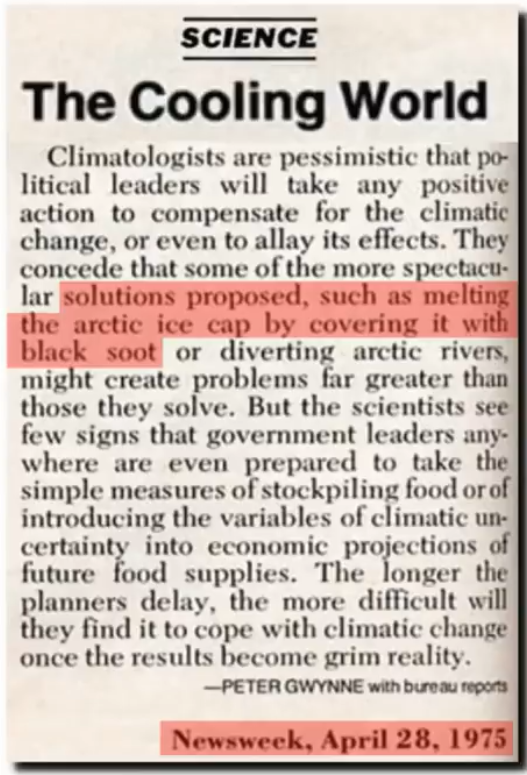
Did you know that scientists in the 1970s were proposing we cover Arctic ice with black soot, so that it would absorb sunlight and melt, to help warm the planet?  

Now they're proposing the exact opposite -- because (most) scientists are people, and (most) people don't even know their own recent history well enough to see past their own arrogance and hubris. 


So for several decades, CO2 was steadily rising, yet Arctic temperatures were steadily falling.  We all know that "correlation is not causation," but what do you call it when there's not even a weak correlation between the hypothesis and the hard data?  (that's a rhetorical question)

To sum it up, what does all this tell us?

Well, for one, it tells us that where we begin and end our temperature data series can give us very different apparent trends.  Warming, cooling, flat -- all can be found over multiple decades, depending on the start and end dates we choose.  So even if we grant the argument that it's been warming for 100 years (which, as we'll see later, is increasingly questionable data), would that even mean anything?  

As far as the Earth alone is concerned, is there anything special about 1895?  Or 1920?  Or 1998?  Aren't these all completely arbitrary starting points, in terms of Earth's climate?

The Earth is 4.5 billion years old -- what does a snapshot of a mere 100 years even tell us?  I would say, "Not much," and the alternating modern "cooling" and "warming" scares seem to agree.  (Imagine looking at a stock chart of only the past 30 seconds and then attempting to use that to make confident declarations about the long-term future trend.  Would anyone be so foolish?)  But we'll return to this point later, when we look at the long-term and very long-term paleoclimatology temperatures.  

It also tells us that humans don't learn much from their own past mistakes.

So, to wrap up this little introduction: 
  • 6-12K years ago, the Arctic was considerably warmer than it is today (with CO2 at "background" levels), but we didn't have media and politicians around to tell us that was the end of the world.
  • In the 1930s and 40s, the Arctic was melting (while CO2 was relatively low) and it was the end of the world.  
  • In the 1950s, 1960s, and 1970s, the Arctic was getting colder (while CO2 was rising) and it was the end of the world.  
  • In the early portion of the 2000s, the Arctic was melting and it was, again, the end of the world.

Maybe trying to judge long-term climate trends based on short-term human time frames is a fatal mistake.

And, to return to the original claim made by media and politicians:  As we've seen from the data, the Arctic is most definitely not "warmer than ever before."  Quite the opposite:  The Arctic is colder than it's been in even Earth's recent past.  Again, this is not "controversial" science.  So why doesn't the general public already know this?

This concludes Part I.

[Click here for Part II: Extreme Weather]

Monday, March 9, 2020

SPX and INDU: Counts Confirmed, but It Brings No Joy

Futures are limit down tonight, and oil crashed (again).  Neither of these things come as a surprise here -- on the forum, I posted on Friday that it was high probability Friday's low would fail directly, and that we could see a large gap down on Monday (the market created a glaringly-obvious b-wave low during Friday's session).

I haven't updated my oil forecast in a year because there's been no change -- my standing count has been that the last crash was the bottom of wave 3 and that a new low was likely still needed.  I first called the top in oil back in 2011, when oil was still trading over $100, and gave a price target of $25, which everyone thought was insane -- but here we are now nearly 9 years later, and the "smartest guys in the room" have finally caught up:


Welcome to the party, I guess.

Incidentally, I called the bounce from 26 to 55, then adjusted my target higher in real-time to 70-72, then called the secondary top in oil as well (I was a little early, but within 4 points), back in May of 2018.  Considering Goldman Sachs apparently missed the top by around 40 points in the wrong direction, I consider that pretty good.  For posterity, here's the last chart I published on oil, in 2018 (it's marked 2019 because, while I can read a chart, I apparently can't read a calendar):


All of this begs the question:  Why isn't Goldman paying me an 8 figure salary?  We may never know.  But what we do know is that the system is going to be getting very stressed now.  

And all of this has left me in a pensive mood.  I have three children; my oldest is in her first year of college.  My youngest is still in grade school.   And the system is garbage.  We all know it.  We've all known it for years.  But the endless cycle of debt and booms and busts has, more or less, worked for the past 50 years.  The problem is, those have been 50 REALLY GOOD YEARS, in terms of humanity's struggles.  We haven't faced any true existential crises in that time.  We haven't faced extinction-level event asteroids, or massive solar flares, or, say, a killer virus that spreads before symptoms are present.  

In fact, we've become so spoiled by these prolonged good and prosperous times that we have to invent pretend crises, and the politicians repeat them every election cycle.  "Oh, the climate crisis, yada yada."  Apparently these people have never looked at the long-term climate of Earth long enough to learn that we are in living in one of the most stable and life-conducive climates of the past several hundred thousand years.  I mean, the end of the last glacial maximum was only ~21,000 years ago, and since then, sea level has risen 400 feet.  But, of course, if it rises another few inches in the next century, we're all going to die (insert "rolleyes" emoji here).


Even short-term, one doesn't need to look back very far (in geological time) to find TRUE climate crises:


Anyway, don't get me sidetracked into this, because I've studied climatology for the past two decades and have literally hundreds of gigabytes of peer-reviewed scientific papers and historical weather data stored on my hard drives, so I could probably write a book on it at this point.  Suffice to say that most what you hear on the news is NOT science, it's hype and superstition designed to get your attention and sell advertising -- it is not designed to inform you in any way, shape, or form.  Most of it is not even mainstream science.

The point I'm getting at is that humans, when they have no true struggles, tend to invent pretend struggles.  It seems to be in our nature to make our own lives seem difficult -- like we don't believe we deserve our lives to be without struggle.

And we've had a long, long stretch of prosperity to the point that few people alive today have (as a collective, not individually) known struggle the way, say, the generations that fought World War II, and lived through the Great Depression did.

And my larger point with all this is that -- during this extended run of prosperity -- we've invented "new" systems that work DURING THE GOOD TIMES.  These systems have not been tested in bad times. 

These systems will fail in bad times.  Again, many of us have known this for years -- but try telling the guy who's hitting jackpot after jackpot on the slot machine that if he keeps at it, he's going to lose all his money.  He won't listen -- not as long as the jackpots keep rolling in.

We're stupid that way.

Anyway, I got to thinking about all this because my long-term count has us approaching the end of Cycle Wave 5 -- and the end of Cycle 5 marks the end of a higher degree Supercycle Wave.

And the end of Supercycle rallies is a huge deal.  It's world-changing.  By my count, even the Great Depression was only at Cycle degree.  Imagine something an order of magnitude worse, and you have Supercycle degree.

I don't think we're there yet (I actually have the year 2025+/- as the window).  But what's going on now got me thinking.  More in another update, perhaps.  Let's look at the charts.

First up, the near-term count that Wave 4 (or Wave A of 4) had completed will be confirmed at the open:


Higher degree:


An even longer-term look, this time in log scale:


And a similar chart, for SPX, which has a better channel -- and a brief discussion on Cycle 4 and 5:


Finally:


In conclusion, there's not much for bulls to grab onto here yet.  C down is still unfolding, and could even have much farther to run.  Do keep in mind that this is projected to be Wave 5 (since we just had Wave 4) -- so if it doesn't extend, it could complete a higher degree waveform, which could either mark the bottom of (larger) Wave 1 of C, or ALL OF C (for the alternate bull count).  Trade safe.