Amazon

Thursday, January 24, 2013

SPX and INDU: Are the Bulls Bored Yet?


Yesterday, the Dow Jones Industrial Average (INDU) effectively reached my target of January 3.  The preferred and alternate intermediate counts are still both bullish -- though there's one small bear hope still remaining (an ending diagonal, not shown) since the key long-term pivots haven't been crossed yet.  Bears would basically have to turn the market more or less immediately in order to pull out a stunning upset, but currently that appears to be low probability.

As it turns out, my observation on October 8 of a three-wave rally into the 2012 high, and subsequent expectation that the market would make new highs after the correction, proved to be accurate.


The long-term chart of INDU notes the next resistance levels.  If bulls can keep pushing a bit farther, they give themselves a shot to run toward the black dashed median line, and potentially as high as the top of the black channel.


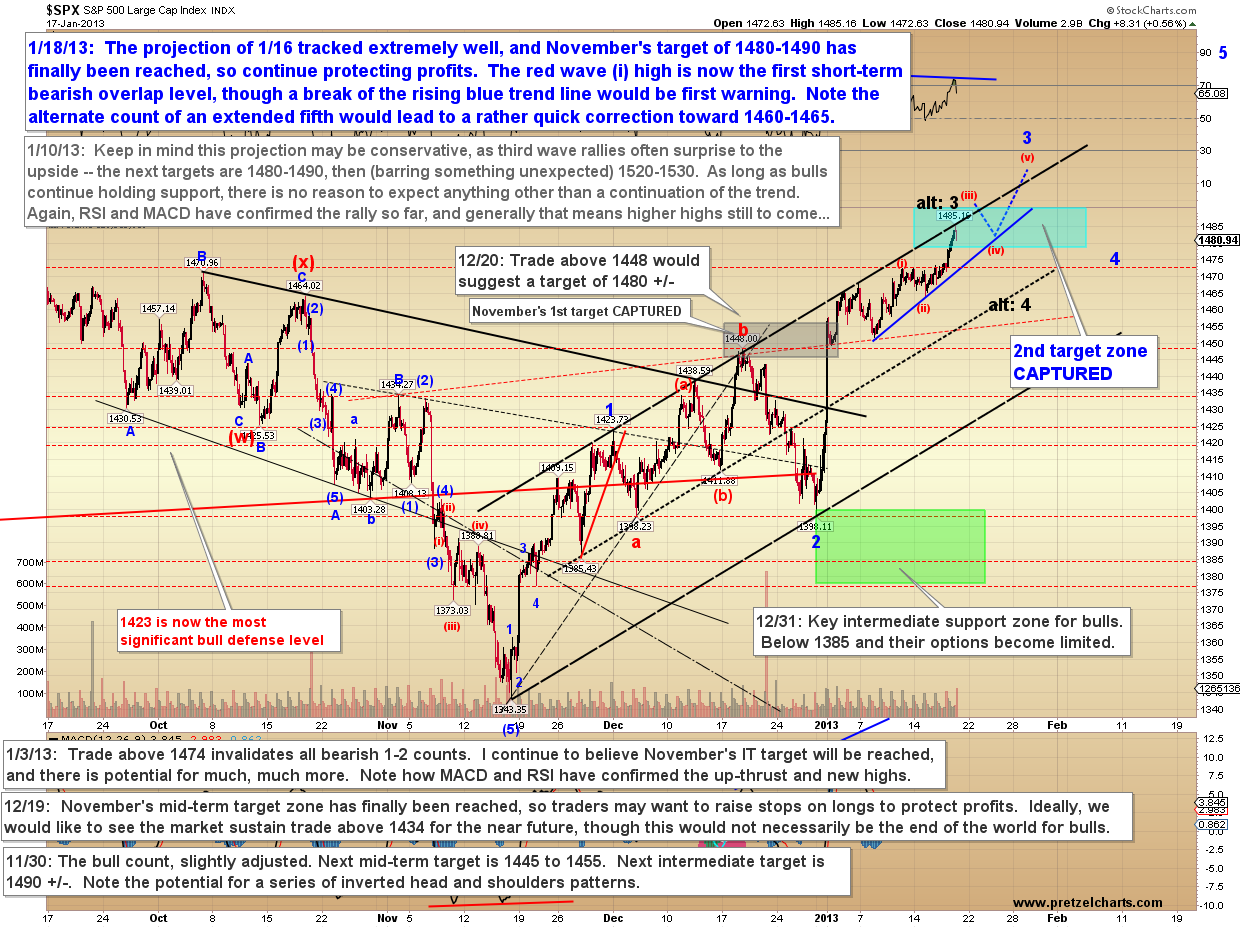
Still no material change in the S&P 500 (SPX), though I presently have some slight concern about the rally from the 1470's being part of an extended fifth wave (black alt: 3 and 4), and INDU has now been added to the markets which have reached my targets, so I continue to feel it's prudent to protect profits.  Beyond that, the market is starting to lull all of us into a bullish stupor -- and when complacency sets in, the market becomes ripe for unexpected corrections.  The blue trend lines would be the first warnings.  (continued, next page)

Wednesday, January 23, 2013

SPX, BKX, RUT: Russell 2000 Approaches Key Long-Term Pivot


The rally has, so far, continued largely unabated, which is what I expected on January 2.  As I warned at the beginning of the year, this rally appeared to fall in the third wave position, which meant to watch for upside surprises and little in the way of downward corrections.  Third waves are powerful trending waves which, as obvious as it sounds, are simply "done when they're done."  The key to trading them is to accurately recognize their potential ahead of time (which we did) and trade accordingly -- and not fall into the trap of calling tops the whole way up (or bottoms on the way down).

So with this wave, I'll continue to look upwards until the wave structure actually turns and suggests we shouldn't (our first warnings will be a five-wave impulsive decline and some key trend line breaks).

The S&P 500 (SPX) is in an interesting position, as it's broken-out ever so slightly above the black trend channel.  This could indicate the current wave is close to exhausting its thrust -- or it could indicate renewed energy... time will tell.  The first key that would suggest at least a near-term correction would be breaks of the two lower blue trend lines.


The Russell 2000 (RUT) is in a very interesting position for the long term.  It's rallied to within a few points of the invalidation level of the most immediately bearish long-term count, and a break above 902.30 will suggest the bulls have at least several months-worth of firepower left, if not a great deal more.  The problem here for bears is that if 902.30 is exceeded, then that would make red wave iii the shortest wave -- and the third wave can never be the shortest, so that would invalidate the most bearish count.  A further breakout over the upper blue trend line could see the rally extend by 15% or more.


To help with anticipation of the short-term, I've prepared a chart of the Philadelphia Bank Index (BKX), which is either still forming a complex fourth wave correction, to be followed by another fifth wave up (black alternate count), or is about to extend the rally directly by another 2% or more (blue).  The two counts appear to pivot on 53.05. (continued, next page)

Friday, January 18, 2013

SPX Finally Captures Long-Standing Target of 1480-1490


Wednesday's update noted that SPX 1467.56 should serve as a dividing line between a deeper correction and a trip directly into my long-standing target zone of 1480-1490.  Amazingly, the market found a bottom at 1467.60 , then proceeded to rally up to 1485 (somebody out there nailed a perfect risk/reward trade entry!).

Note the 32 point trade trigger of December 20 was also finally captured in the process (1448 to 1480).  Going back to November's updates, there was one big scare along the way (when 1411 broke) which switched my public stance to neutral, but all the blue target boxes since November have now been reached.  Even before the fiscal cliff scare, my "safe" target of 1445-1455 had already been captured; so all told we've captured a bit over 100 points of the rally since November 19, 2012.

Which brings me to a thought I'd like to share with readers:  My biggest complaint with myself from the recent past is that I didn't stick to my bullish guns in the updates during the fiscal cliff scare... and I'll tell ya' exactly why I didn't, too: simply because I'm not so arrogant as to think I'm never wrong. With the market in that position, with a big third wave decline as a very real potential, I worried about "convincing" anyone to go long and possibly having my readers get caught on the wrong side (if I was wrong). So I switched myself to neutral publicly, because that was a dangerous position for the market, and especially dangerous for cash traders. Privately, I remained bullish.  In retrospect, obviously, I wish I had stayed more publicly bullish.

It's a tough gig. Losing your own money is one thing, and I view that as part of the game... but feeling like you "lost" someone else money is almost unbearable at times. I've lost sleep on many nights over this -- and not just when I'm wrong. Sometimes just when I'm bold and worried about being wrong and misdirecting someone. 

Respect to the brokers in our audience -- you know who you are!

In any case, the question now, of course, is: what next?  Well, I don't get 'em all right, so I can't promise anything, but it does appear that SPX still needs a higher-degree fourth wave correction and fifth wave up, at the minimum.

As always, once a target zone is reached, reversals become a bit higher probability.  There are some indications that the rally could be nearing a turn, but as I've been noting all month, this is a third wave rally, and third waves love to blow up everyone's favorite indicators (this is actually why I haven't been publishing much lately about divergent sell signals and such -- those types of technical indicators rarely work during third waves). 

The traditional count is outlined in red, but the alternate count is not at all unreasonable and would be suggested with trade beneath the red wave (i) high.


The Philadelphia Bank Index (BKX) is also hinting at more upside after the next correction.  Note the pattern here, and an upside breakout over the dashed blue line should lead to 54.80-55.


In conclusion, as I've mentioned since the beginning of the year, I have no intention of trying to call a top in this wave until I see the first impulsive decline.  That said, a long-standing target zone has been reached, so it's time for traders to decide whether to take profits or chase the move higher with stops.  Trade safe.

Reprinted by permission; Copyright 2012 Minyanville Media, Inc.

Wednesday, January 16, 2013

Euro Update: Yesterday's Call Blown, Targets Postponed or Negated


I was going to take today off, but I felt obligated to update Euro.  In yesterday's update, I discussed the fact that Euro appeared ready for a deeper correction; however the wave I was anticipating fell well short of my expectations, and Euro found strong support right where it needed to.  It's now formed an incredibly symmetrical reversal pattern, and is almost certainly headed to retest or (more likely) best the previous high.

In real-time, this pattern became apparent as it unfolded, but that doesn't do readers any good, and I apologize for blowing this one.

Note the bear hope that still remains is depicted by the alternate count.  If this is the alternate count unfolding, that count is quite bearish, but I'm not going to pretend it's what I was expecting yesterday.  The alternate count is, in fact, considerably more bearish than the count I had posted.   

The white ABC forms a complete fractal, and that suggests the alternate count is lower probability -- but because these are fractals, a complete fractal sometimes only marks the first wave of an even larger fractal.  A triangle would also not be entirely out of the question here, so be on alert for that pattern if the rally falls short of the previous highs and embarks on a deep correction.

It pays to be aware that if the Wave C low is broken in the near future, an extremely sharp decline is almost certain to ensue, and yesterday's targets will become active once again -- so if one is bullishly inclined, the stop-and-reverse (SAR) level is clear.  On the other side of that coin, a break of the wave B high should lock-in the corrective nature of the decline. 


My apologies again for reading this one wrong yesterday and I'll return with the equities updates tomorrow.  Trade safe.

SPX and Euro: Euro Ready for a Correction


In yesterday's update, the preferred short-term count expected the S&P 500 to decline to 1461 +/-, then reverse to new highs.  The market found a bottom two points shy, at 1463, then moved up to make a very marginal new high.  Normally, we'd now expect a standard five-wave impulsive rally to unfold over the near-term, but I've outlined a second potential path because the option's still open, and I have a suspicion about what the market may be planning here for the short-term.  Targets for the two most-likely near-term paths, and levels to watch to differentiate the two, are listed on the chart below.


Note that both short-term counts presently expect this move to resolve higher, this is simply an option to be aware of, because expanded flats (the green path outlined above) often get traders on the wrong footing, since they almost always kick out the last swing low before reversing higher -- in other words, they behave just like the move I predicted yesterday.  This is basically a larger fractal of the same type of structure.

The hourly SPX chart is shown below, and there's nothing in the charts yet to suggest that November/December's upside target zone won't be reached -- though the market has now come within 7 points, and sometimes "within a few points" is as good as it gets in this business, especially for long-standing targets.


The main thing bothering me right now for equities has nothing to do with the equities charts:  I've been trading the euro/US dollar currency pair all night, and I suspect euro is on the verge of a steep decline toward 1.312-1.314 in the next few sessions.  Although there's no guarantee this will impact equities, it's a factor to remain alert to.

Below is a chart of the FXE currency shares euro trust.  While the numbers here vary slightly from the actual Forex market, the wave count is the same.  The retrace target is listed using the actual Forex rates -- if the most recent rally was all of wave (5), then an even deeper correction will ensue.

NOTE:  Intraday real-time adjustment on Euro -- I reworked my micro count in Euro/USD and it is entirely possible that an ABC completed at last night's low.  It all comes down to key support now: as long as 1.32559 holds as support, it may move to new highs from here... and bears probably don't want to see it back above 1.33471 at this point, or it could easily go back into launch mode.  Below 1.32559 and the target becomes active.

(continued, next page)

Tuesday, January 15, 2013

Time for Caution, Though No Reason to Be Bearish Yet


The updates have been suggesting higher prices all month, and the waves are still pointed upwards for the moment -- but I do want to show a few charts that act as caveats and suggest some degree of caution is in order.  The equities markets have remained a bit fractured, in the sense that related markets often seem to be suggesting completely different things -- and this is still making it difficult to predict exactly where we are in the larger picture.  I continue to lean bullish, but a little caution is now in order.

To illustrate the fractured nature of things: the S&P 500 (SPX) is suggesting a smallish correction that holds above 1451, then on to new highs.  But the NYSE Composite and Philadelphia Bank Index (BKX) are hinting that a larger correction may ensue.  There's simply no way to know for sure which it will be at this phase: we're too close to the recent highs to project much to the downside. 

Let's start with the short-term SPX chart.  This chart shows what is almost-certainly a three-wave rally into the 1472 print high, which suggests an expanded flat is unfolding (or already complete).  The expanded flat seems to connect the rally from 1451 to the wave that is unfolding now, which suggests the first part of the rally is simply wave (1) of (5) of the larger wave 3.

Note that the corrective fractal could be complete at the red wave A/alt: (4) label, in which case higher prices are due directly; this appears less likely, but trade beneath 1465.69 is required to confirm the 1461 target.  The only way to eliminate the bullish (1)/(2) potential of this chart is for the market to break below 1451.  Compounding the issue is the fact that the waveform from 1451 is exceptionally weird.


Moving out to the 30-minute SPX chart, we see how this wave fits into the bigger picture (labeled as red (i) (ii) and (iii) on this chart).  Note the alternate count that ALL OF wave 3 has completed.


There are no meaningful signs of a turn yet, but both NYA and the Philadelphia Bank Index (BKX) are sporting the potential of complete rallies.  The challenge here, though, is that the same structure discussed in SPX is entirely possible, and the wave labeled as "v?" may only be wave (1) of v.  There's simply no way to tell this early, but I would be remiss not to warn. (continued, next page)

Monday, January 14, 2013

A Survival Guide for Bears in a Bull's World


Ah, it's open season here my friend.
It always is; it always has been.
Welcome, welcome to the U.S.A.
We're partying fools in the autumn of our heyday.


And though we're running out of everything,
we can't afford to quit.
Before this binge is over,
we've got to squeeze off one more hit:
We're workin' it.

.....

We got the short-term gain, the long-term mess,
we got the suffocating, quarterly consciousness.
(Yes man, run like a thief.)

New York to Hollywood, hype and glory,
special effects, but no story.
(Yes man, run like a thief.)


- Don Henley, Working It

There's been no material change in the market outlook, so today I'm going to focus on discussing the world's fundamental debt problems, and how those problems may impact investor psychology.

Let's imagine you found yourself in an H.G. Wells novel, and used his famous machine to time-travel into the future to a random, unknown year.  As fate would have it, you just happen to land in the exact year when there's a worldwide financial meltdown -- but before you can find out what year it actually is, your time-machine whisks you back to the present, and then ceases functioning.

You are now in possession of powerful, and somewhat frightening, information.  You know this financial meltdown will happen at some point in the future, but the problem is: you don't know when.  It could be in two weeks, it could be in two decades.

You are an investor and a trader, so suddenly you look at the market and wonder:  "What if this future I experienced happens tomorrow?"  You react emotionally, rightfully worried, and you immediately pull all of your investments out of the market.  Then the market starts going up, and you wonder again:  "Hmm.  What if this future happens many, many years from now and I miss out on everything in-between?"  You have powerful knowledge of the future -- but how can you profit from knowing something will happen, if you have no actual time frame for knowing when it will happen?

I use this analogy because I think many bears have fallen into a very similar trap for years.  Bears tend to be smart, free-thinking individuals, who are a bit contrarian in nature.  This feeling of being contrarian isn't really by choice; it comes from the fact that bullishness is packaged as the "American Way," and the mainstream media often mocks bears openly with a variety of semi-demeaning nicknames.  These names run a wide gamut, from Nouriel Roubini's media-dubbed nickname of "Doctor Doom" all the way to Peter Schiff's media-dubbed nickname of -- you guessed it -- "Doctor Doom" (nobody ever accused the media of being creative).  The mainstream media's propensity to nickname anyone who's bearish as "Doctor Doom" (also: "Professor Doom," "Mister Doom," "Cousin Doom," "Big Daddy Doom," etc.), understandably makes bears feel they are ostracized and outcasts.

The funny thing is: many bears started off as bulls, and then felt they had some type of catharsis -- some type of "informational awakening" -- which converted them into bears.

I had this fundamental conversion experience in the late 90's, and yet I have been very bullish on the market at several points since.  I'll explain why in a moment.  In my heart, I'm bearish on the fundamentals, because I believe the massive debt that the world has accumulated is completely unsustainable.  We have reached levels of public and private debt that are wholly unprecedented, to the point where the term "record levels" is an understatement.

According to the Bank for International Settlements, the debt of governments, private households, and non-financial companies rose from 160% of GDP in 1980, to 321% of GDP in 2010.  After the figures are adjusted for inflation, the world's governments have more than four times the debt levels of 1980, and private households have more than six times the debt.

(continued, next page)