Commentary and chart analysis featuring Elliott Wave Theory, classic TA, and frequent doses of sarcasm from the author who first coined the term "QE Infinity." Published on Yahoo Finance, NASDAQ.com, Investing.com, etc.
Join the ongoing discussion with our friendly, knowledgeable, and collegial forum community here!
Amazon
Wednesday, December 31, 2014
SPX, BKX, INDU, GE: GE a Good Short Op as Potential Turn Draws Near for Major Markets
In Monday's update, I noted the following on the S&P500 (SPX) chart: "Downside risk may be exceeding upside potential at the present moment." During that session, SPX made a new high by less than one point, and then proceeded to generate a 14-point reversal.
Frankly, I have spent a ludicrous amount of time staring at charts since yesterday's close, so I'm going to keep the body of the article fairly light and let the charts do most of the talking.
First off, let's take a look at the Philadelphia Bank Index (BKX), which has all the ingredients in place for a complete rally:
For perspective, here's another look at the long-term SPX chart. For the time being, I remain in favor of the thesis that we are completing a higher degree fifth wave, to be followed by a significant correction. I'm not closed to the more bullish options, however, I feel we can adjust to a more bullish footing in real-time as and if needed.
The 2-minute SPX chart shows an impulsive decline from the recent 2093 high. The chart discusses the options further:
(continued, next page)
Monday, December 29, 2014
SPX, RUT, COMPQ, BKX: The Easy Money May Be Over for Now
Some noteworthy events have occurred in various markets since the last update:
1. The Russell 2000 (RUT) captured my 1214-20 target zone (high: 2017).
2. The Nasdaq Composite (COMPQ) broke the November highs, thereby validating my preferred wave count and capturing its minimum upside target.
3. SPX finally captured the 2090-2100 target zone from early December.
This is where things start to get a little more challenging. For the last couple weeks, the charts were pretty clearly telegraphing that the market wanted to go up, but now numerous target zones across multiple markets have been captured.
Let's start off with RUT. RUT, like most markets, is lacking a clear fourth wave to allow us to more definitively triangulate the wave structure. It's quite possible that this simply means that a fourth wave is still needed -- but the wave structure is such that there are potentially enough waves in place for a complete rally. As I've discussed previously, when you're dealing with a strongly-trending rally wave that's a bit vague (such as this one), the first impulsive decline will be a more concrete signal that the tide may be turning in the bears' favor.
(If you're new to Elliott Wave Theory, you may find the following article helpful: Understanding Elliott Wave Theory, Part II)
Next is COMPQ, which has also captured its anticipated minimum upside target:
SPX is in a similar boat. So far, the rally has simply ground higher and any attempts to anticipate a fourth wave have been premature, which is one of the reasons it's not a bad idea to await an impulsive five-wave decline before becoming too attached to the idea of a turn.
(continued, next page)
Thursday, December 25, 2014
Understanding Elliott Wave Theory, Part II
(Author's note: This article was originally published in May, 2012. Part I can be found here.)
In the 1930’s R.N. Elliott made what was, at the time, a
revolutionary discovery: markets are of a fractal nature. A fractal is an object that displays
self-similarity across all scales -- in this case, the patterns in a one-minute
chart are smaller versions of the patterns in the hourly and daily charts, and
so on.
Elliott also discovered that these market fractals seem to
follow many natural mathematical laws, such as the golden ratio (1:1.618) found
throughout the natural world. Certain
personalities find this outrageous: how could a stock market have anything to
do with the golden ratio? Apparently
they view man as being separate from nature, as opposed to being part of
nature. I find Elliott's discovery to be not only believable, but painfully
obvious.
The whole of
reality conforms to mathematical laws and aesthetics;
how could any
market possibly operate outside of those laws?
Man is forced to work within natural laws, and as a result,
those laws impact our behavior in quantifiable ways. We all have an innate
discomfort with heights -- because the law of gravity has impacted our
psychology and altered our behavior (nobody jumps off a ten story building
thinking it's a good idea). Nature's laws impact man's psyche, both consciously
and subconsciously; and our psyche impacts our behaviors in all things,
including markets.
R.N. Elliott originally discovered the theory through his
detailed back-study of decades of price charts. I’m going to simplify a bit,
for the sake of time, but the essence of his discovery is that the market
advances its position forward (note "forward," not "up" --
advancement is relative to what the market is trying to accomplish, either up
or down) in five-wave moves: wave one forward, wave two back, wave three
forward, wave four back, wave five forward. It then corrects that advance in
three-wave moves in the opposite direction: A forward, B back, C forward.
The moves that advance the market's larger trend are called
"motive" waves, and the moves against the larger trend are
"corrective" waves.
What is most interesting is that these fractals apply across
all time frames: so each advancing wave within a motive wave (waves one, three,
and five) is composed of an even smaller five-wave sequence. And each
correction in a motive wave (waves two and four) is formed by an even smaller
three wave correction. Instead of walking you through this to infinity, and
eventually causing your head to explode, it’s easier to understand when you see
it on a diagram:
As a result of the fractal nature of the market, R.N.
Elliott was also able to determine certain rules which govern price movement.
For example, wave 4 virtually never crosses into the territory of wave 1
(except during special patterns, which I won't be getting into here since this
isn't intended to be a book). There are also rules which govern the length of waves
(wave 3 is never the shortest), the form of corrections, and so on. Having
concrete rules which govern price movement means that, at times, the market in essence
"locks" itself into certain future behavior; once part of the fractal
is formed, it must be completed. This affords a degree of predictive
value.
To draw an example, it is extremely rare to find an isolated
five-wave sequence in the market. There
are certain exceptions to this, but the majority of the time, one five-wave
sequence will lead to at least one more
five-wave sequence in the same direction.
Thus, if one can locate the beginning and end of one five wave move, one
knows to expect another similar move to follow (usually after an a-b-c
correction). The fact that five wave
moves virtually always occurs in the direction of the next larger trend also
helps us locate the overall trend of the market.
In addition to this, the edge provided by Elliott Wave is three-fold compared to
classic TA:
1)
The entire market is the pattern. There’s no waiting around all day for head
and shoulders patterns to show up.
2)
Elliott’s formulas allow one to calculate
targets for many patterns which are not recognized or addressed in classical
TA.
3)
Elliott Wave provides an added degree of
probability, and can often suggest what the market will do next -- and even
suggest whether a more widely-recognized pattern will succeed or fail.
To draw a real-life example of the 3nd point and
advantages therein: long-time readers
will recall the triangle pattern that formed in in October/November of
2011. Triangles are usually continuation
patterns in classic TA, and the majority of technicians believed the triangle
marked a consolidation of the October rally, and that it would ultimately break
out higher. However, Elliott has
specific rules for triangle patterns, and using the edge provided by Elliott
Wave, I was able to correctly predict that the market would not break out from
this pattern, but would instead break down and head lower (See November 17,
2011: SPX
and BKX Update: Next Move Should Be
Lower).
I can say without shame that my longer-term projections in
that article (SPX to low 1000’s) turned out to be a miss after the coordinated
central bank intervention in late-November (known to bears as the Thanksgiving Day Massacre) – sometimes we
simply can’t see that far down the road and anticipate every coming twist and
turn. I believe to this day that had the
central banks not intervened at that time, then the market would likely have
reached my projections. Apparently, they
believed it too – hence the intervention.
As with most things worth knowing, of course, the devil is
in the details. It takes time and practice
to begin to accurately interpret the fractals.
And even after years, there are moments when it’s difficult to get a
bead on the market. As a result, there
is an “art” to Elliott Wave analysis that seems to come only with repeated
study and practice.
Some days, the market is simply indecipherable, even to the best
technician – but the advantage provided during these times is that Elliott Wave
allows us to examine and assign probabilities. This often results in analysis that takes the
form of an If/Then equation. IF the
market crosses X price point, THEN it is highly likely to reach the Y price
point. I’m sure most traders do not need
to be told the value of such equations – almost all classical technical
analysis follows similar, albeit more basic, equations.
I don’t use Elliott Wave as the end-all in my analysis, but
it is definitely my analytical tool of choice.
There are times it’s difficult to read the market, and times the market
forces us into a “watch and wait” mode – no form of analysis can tell you with
certainty what the market will do every second of every day. But over the years I’ve found -- at its best --
Elliott Wave Theory is almost magical in its ability to allow us a predictive
glimpse into the market’s future.
Basics of Technical Analysis, and Understanding Elliott Wave Theory, Part I
(Author's note: This article was originally published in May 2012.)
In this series, I’m going to attempt to explain a bit about
market analysis, with a focus on Elliott Wave Theory. Later
in the series (after we’ve covered the
basics), I’ll share some ways to utilize these tools for your own
benefit. A small portion of this has been reprinted from some of
my earlier articles, so if it sounds familiar, that's because I
plagiarized myself. My attorney assures me that I am immune from
litigation, but I have filed suit against myself anyway, because I can't
have people stealing my work!
Anyway... First, I do want to briefly address fundamental analysis. My primary focus as a trader involves
technical analysis, for reasons I will explain shortly – however, unlike many
technical analysts, I do believe that fundamental analysis has value. I believe it
serves as a foundation to interpreting charts across the longer time-frames,
and aids in understanding what is possible and likely.
Conversely, some fundamental analysts seem to believe that
projecting the market using price charts is some kind of “voodoo.” I suppose this is understandable; most things
we don’t understand carry a certain mystique to them. It’s important to realize that price charts,
all by themselves, contain all the collective
knowledge about a stock or index.
People act on what they know or believe, so it stands to
reason that people buy or sell securities based on what they know and believe
-- thus(and here’s the critical point about technical analysis) everything known about a given security by
all the shareholders collectively
is reflected in a price chart. When an
insider makes a trade, it influences the price of that security, and leaves a clue
which can be read on the chart. When a
huge hedge fund gains a piece of critical information (usually well ahead of
the public) and starts buying or selling a specific stock or commodity, that
action leaves its mark on the charts… and so on. Thus the charts point the way ahead.
The goal of a fundamental analyst and a technical analyst
(one who studies charts) is the same:
they both seek to project the future.
Their methods, while seemingly different, are also quite similar in many
respects. For example, a fundamental
analyst might look at Apple and try to project how many iPhones and iWidgets
will be sold next quarter, and how that will influence profits, growth, etc. Then he takes all his research numbers and
derives a projection of the company’s outlook -- largely based on what’s
happened in the past. He then plugs
that projection into a formula to arrive at a future share price target, which is
also based on how things have performed in the past.
A technical analyst does the same thing, except he looks at
the charts directly (which, as we just learned, contain all the knowledge of
the collective) and cuts out the middle man.
He seeks patterns which convey information: When price has moved up by x number of
dollars, and then moved down by x percent to create a certain pattern, how has
the market usually performed in the past?
Both forms of analysis are
based on past performance and on future probability – they just get there
by different means.
The weakness to fundamental analysis is that there are a
great many variables which the analyst simply cannot foresee. Study what happened in 2007-2008 for an
example. Many stocks looked great, and
projected earnings looked great, and their futures looked so bright that
everyone was wearing shades – but their share prices collapsed anyway, in a
spectacular fashion. In September 2008,
did anybody care about how many iWidgets any given company was projected to
sell in the fourth quarter of that year?
Some fundamental analysts saw what was coming back then;
others didn’t. Likewise, some technical
analysts saw what was coming (myself included) and others didn’t. But the
probability of a crash was all telegraphed well in advance on the price charts –
one didn’t even need to turn on the TV to see it coming ahead of time.
The big advantage to technical analysis: we technical
analysts were able to arrive at actual price-targets for the crash, in
real-time, while it unfolded.
Fundamental analysts knew it was “gonna be bad!” but that type of
analysis is simply unable to time the market with that degree of accuracy. This is why the majority of fundamental
analysts don’t even try to time the market, except in broad strokes: their
system is ill-suited to it.
So, now that we’ve gotten that out of the way, let’s discuss
a more detailed form of technical analysis, called Elliott Wave Theory.
On the surface, Elliott Wave is a unique way to understand
why the market does what it does, and a detailed tool that allows us to project
future price moves by extrapolating the fractals and patterns found on the
charts. The theory runs far deeper than that, though.
At its core, Elliott Wave helps us to understand something
much more meaningful than markets: it helps us to understand human nature. The
patterns formed in the market are, in part, a direct reflection of investor
knowledge, and more importantly, investor sentiment. Like most things in the world, sentiment
fluctuates in cycles.
You can observe the symptoms of this cyclical tendency in
the news reports. One week, you’ll see
nothing but happy headlines, as sentiment hits a positive cycle and everyone
forgets about all the troubles in the world:
“Rally Takes off as
Market Cheers Job Report”
“Stocks Rise as Greece
Agrees to Austerity Measures”
“Dow Closes Higher
after Bernanke Announces He’s Dying His Beard”
(If you were rooting for that sentence to end without the last two
words – shame on you!)
Then a short time later, it’s as if everyone forgot how “good”
everything was just a few minutes ago, and suddenly it’s nothing but bad news
again:
“Rally Crumbles as
Market Boos New Jobs Report, Which Was Pretty Much Exactly the Same as the One
They Cheered Last Month”
“Stocks Collapse as
Investors Realize They Don’t Actually Know What Austerity Means”
“Dow Suffers Biggest
One Day Loss on Record when the Market Realizes It’s Afraid of Snakes”
As I’m sure you’ve seen, even the exact same news item can be received well on one day and poorly on
the next – highlighting my point that sentiment is cyclical. In reality,
outside of certain “black swan” events, the news doesn’t drive the market
directly -- it merely reports what the market did after the fact and attempts
to explain it. Otherwise, good news
would always cause the market to go up, and bad news would always cause it to
go down. But as you’ve certainly
noticed, it doesn’t work that way.
The other problem with news is that, even if it was a prime mover for the market, it
always arrives too late for you to make use of it. If you’re dead set on trying to assign a “reason”
for what the market did that day, you could simply look at the closing prices
to figure out whether sentiment was good or bad (up = good; down = bad), and
then make up your own random explanation, just like the news does: “Market Crashes As Investors Realize that
Your and You’re Are Actually Two Different Words.”
Fortunately, we don’t need to pay attention to the
lagging-indicator news, because these sentiment cycles often leave clues
telegraphing their arrival and departure.
These clues are found in the price patterns. As we discussed, all the collective knowledge
of investors is reflected in the numbers on the charts. By tapping into that knowledge, Ellliott Wave
Theory can, at times, recognize and anticipate the sentiment and cycles in
advance. And since sentiment goes a long
way toward driving the price, we can then either:
1. Anticipate
the market’s future price movements before the moves actually occur, or;
2. Gain a reasonably accurate window into what’s
likely to occur if the stock or index crosses a certain price threshold.
The market's price movements are, in the end, a reflection
of human nature. And here’s where things
become truly fascinating:
By rule of intrinsic design, human nature must be
universally reflected in all human constructs, be they markets,
governments, or otherwise. Once you
unveil one universal aspect of human nature, you are often able to locate the
same common thread running throughout other human activities. This is one of
the fascinating things about Elliott Wave Theory:
it seems to apply to patterns found not only in markets, but in the rise
and fall of nations, and even entire civilizations (as well as the ebb and flow
of many other things in the natural world). I have studied and applied it for
many years, and continue to be in awe of its frequently-uncanny ability to
anticipate the future.
It is important to note that Elliott Wave Theory was derived from back-testing. Back in the 1930’s, R.N. Elliott studied decades of charts at various time frames, and discovered that there were certain patterns which repeated across all time frames. These patterns were of a fractal nature; in other words, the patterns on the one-minute chart join together to make up identical larger patterns on the hourly charts, which in turn make up identical larger patterns on the daily charts – and so on. He developed Elliott Wave Theory as an attempt to quantify and explain these patterns.
In the next chapter, we’ll examine the underlying patterns that form the basis of Elliott Wave Theory.
Part II can be found here.
Wednesday, December 24, 2014
SPX, RUT, BKX: SPX, BKX, and INDU Capture First Targets; What Next?
Since last update, SPX and INDU made new all-time highs, thereby validating the preferred count and completing the first portion of my intermediate thesis. From last Friday:
Most technicians are either still bearish and expecting an imminent top shy of the all-time high, or they're viewing this rally as wave (3) of (something) and expecting a moon-shot. Is it possible that virtually everyone's wrong?
We can now confirm that those expecting a top shy of the all-time high were wrong, at least. Now we try to figure out if we're actually closing in on a top, or if the moon-shot rally will materialize. Let's see what we can glean from the charts.
First off, RUT has, thus far, fallen just a hair short of making a new high. In a perfect world, I'd still like to see a new high there -- but while we're on that subject, incidentally, we are now into a zone where a failed fifth wave becomes possible. In my experience, the term "failed fifth" is often misused -- for a true failed fifth, there should actually be five waves present in the structure (but the wave fails to make a new high or low, hence "failed fifth.").
Some folks were talking about a failed fifth in RUT back when RUT was near 1150. As I saw it, at that point, RUT did not actually reconcile as a complete five wave structure, but was instead only 3-waves up (i.e.- it was (1)/(2)/(3), or a possible ABC). That's why I never took the failed fifth idea seriously: Without five waves present in the structure, a "failed fifth" isn't a valid potential in the first place. Now, however, there are five waves up in RUT -- so, while a failed fifth wave is still a long shot, at least now it's technically possible.
Ignoring the failed fifth idea for the moment, it's difficult to triangulate the current wave, since there's no clear fourth wave in the structure. I'm drawing my best guess target of 1214-1220 using proprietary formulas, but without a fourth wave to triangulate the count, I can't currently add or subtract any confidence to/from that target.
SPX followed the blue path outlined in the last update. Since it reached a new all time high, and there are enough waves present, we do have to start considering the potential that (5) is complete or nearly so. If we take our cue from RUT, though, then SPX may still need to unwind another fourth and fifth wave.
The decline into the end of the day yesterday was clearly impulsive, but the move into the all-time high was sloppy enough that I can't be sure the decline wasn't simply wave c of an expanded flat. Nevertheless, I'm very marginally favoring the idea that yesterday's decline is the start of red wave (4), and will thus continue at least a bit deeper, perhaps after a small bounce to start the session.
If the big picture preferred count is correct, then we're likely close to completing black wave 5 on the chart below.
A factor that's a bit harder to quantify at the present juncture is seasonality. Traditionally, seasonality is quite bullish this time of year, and this factor, combined with RUT, are probably the two main things leading me to think we may still see the (4) and (5) unwind as shown on the chart above. Another 4/5 unwind might also be a nice bearish sentiment killer. All that said, if there's to be a surprise reversal in the near future, it may not follow the "usual" expectations... (continued, next page)
Monday, December 22, 2014
SPX, NYA, RUT: No Material Change Means It's Time to Play Devil's Advocate
No material change since Friday's update (please refer to it if you missed it), but I do think it's a good time for bulls to stay on their toes. As I see it, there are two major inflection points wherein bears might surprise everyone and seize control, and the first such inflection point is essentially upon us (the second one comes shortly after new all-time highs). It is a little bothersome that sentiment seems to be outrageously bullish, and that pretty much everyone is treating new all-time-highs as a given.
To be fair, I do still expect new highs in SPX, and so far that market's come within 2 points of breaking the old ATH. But I always like to play devil's advocate to myself in the interest of staying as objective as possible. So, from a technical standpoint, we do need to stay aware of the current inflection point, which is probably best revealed via NYA:
No change to the big picture:
SPX has several near-term options, and it's impossible to sort one from the other at this stage. Meanwhile, perhaps the more meaningful takeaway from this chart is that SPX appears close to completing five waves of rally. If my intermediate thesis is correct, this is the fifth wave rally of a larger fifth wave rally of a still larger fifth wave rally -- and a deeper correction will follow.
While there's no room for complacency this close to a major swing high, unless the picture suddenly changes significantly, RUT is probably going to keep me in the near-term bull camp until it breaks 1213.55:
In conclusion, we may be close to unraveling a fourth wave correction, but ultimately I'd still like to see SPX and RUT make new all-time highs before embarking on a deeper correction. Trade safe.
Friday, December 19, 2014
SPX, RUT, INDU, COMPQ, BKX: What if Virtually Everyone Has it Wrong?
I'm going to reach into the archives during the first portion of this article, in order to lay the groundwork for my ongoing thesis that perhaps just about everyone (bulls and bears alike) is about to be duped by this market.
Back in November, I put forth the theory that the market was unwinding a high-degree fifth wave, which would then be followed by a significant intermediate correction. On November 17, I published a "best guess" target of 2065-75 for that wave. But as we reached that target zone, while I thought a correction was due, I did not believe the rally was over yet -- to the contrary, on December 8, I wrote the following:
Friday's market didn't perform the way a third wave should, and this has left a number of complex options open. The charts might get a little confusing, so before we get into that, I'm going to give a brief synopsis of my thinking regarding the intermediate term:
1. RUT and NYA have, so far, failed to make new intermediate swing highs. Odds are good that needs to happen before a meaningful top becomes possible.
2. SPY has been up seven out of the past seven weeks. Over the past 18 years, this has happened seven times (go figure). In 100% of those prior cases, the market formed, at best, a minor correction before making new highs. In 0% of those prior cases, the market formed an immediate major top.
3. Last week, we looked at an RSI top study. Given the market's behavior in the past, it remains highly unlikely that any kind of final high is in place.
4. Therefore, while there is not yet enough pattern present to determine the exact depth of any (pending) near-term correction, I do believe it will simply be a correction, and resolve with new highs.
5. I currently believe the odds are good for an intermediate correction to follow after the next rally takes us to (presumed) new highs -- but let's not put the cart too far in front of the horse...
As the market decline deepened, I'll admit that I began to wonder if I had been "caught looking" at the top, and if maybe I was wrong on points #4 and #5 -- nevertheless, I continued to refrain from becoming bearish, due to the other above-mentioned issues having solid weight in my mind. In fact, on December 15, I wrote:
If this had been a normal market for the past few years, then I'd probably already be rabidly bearish. But this has not been a normal market -- and once bitten, twice shy, as they say. Or as George W. Bush so eloquently put it: "Fool me once, shame on you. Fool me twice, and I'm going to punch some central bankers."
I mean, let's face it, bears have been here a few times before. It goes like this:
1. Support levels begin failing, VIX spikes.
2. The pattern starts to look exceedingly bearish.
3. CNBC trots out several analysts who all share the nickname "Dr. Doom," and they each talk about how the fundamentals are garbage and the market is clearly headed to zero or below.
4. Bears see a bunch of green in their accounts and start to feel excited...
5. One of the major central banks announces some radical new program, such as that it will be providing free, unregulated personal printing presses for each and every banker who'd like one.
6. SPX gaps up 257 points, and shorts are left running for cover as the market rallies relentlessly.
Well, we can't say we haven't seen this movie before.
And, just to wrap the archives up, on December 17, I ended with:
In conclusion, there isn't much to add down here. If the decline is simply a correction, then it's in the zone where it could bottom -- the first thing bulls want to see there is sustained breakouts from the down trend channels. If it isn't a correction, then bears are likely just getting warmed up for an intermediate decline. It's interesting to note we seem to have reached an important inflection point as the market awaits more info from the Fed.
As we know, that inflection point was accurately identified, and generated the current breakneck rally. That brings us to the present. And here's where it gets really interesting: What if my original November hypothesis was correct?
Most technicians are either still bearish and expecting an imminent top shy of the all-time high, or they're viewing this rally as wave (3) of (something) and expecting a moon-shot. Is it possible that virtually everyone's wrong?
The potential I have been favoring, and will continue to favor for the time being, was as I outlined on December 8, as follows (sorry for the repeat below, but it saves readers from having to jump back to the beginning):
4. Therefore, while there is not yet enough pattern present to determine the exact depth of any (pending) near-term correction, I do believe it will simply be a correction, and resolve with new highs.
5. I currently believe the odds are good for an intermediate correction to follow after the next rally takes us to (presumed) new highs -- but let's not put the cart too far in front of the horse...
This has been a bear-killing rally since 1820. And if the current rally does indeed reach new all-time highs, it could be the proverbial straw that breaks the camel's back. Bears will feel like it's the end of the world, and many will finally capitulate. Bulls will feel unstoppable, as their mantra is again rewarded: "Buying the dip ALWAYS works," they'll say to all the downtrodden bears, who have vowed to never again short the market.
It's the perfect setup for an intermediate decline.
Fifth waves aren't really supposed to be obvious, otherwise there would be no one to buy them, and we'd never even have a fifth wave (no buyers = no fifth wave). Ever wonder who the guy was who bought the market at the exact top tick of a long-term peak? He was the guy who had no clue we were in a fifth wave. And he wasn't alone, it's just that all the other folks who had no clue we were in a fifth wave got in a few points earlier.
The chart below shows my intermediate preferred count:
The moon-shot count remains possible, but I think we'll be able to identify the inflection points in real time well enough to know if the market is on the moon-shot track, so I'm not going to worry about it just yet. I think the preferred count presents an excellent setup for a surprise sustained decline -- because for a sustained decline to materialize, the majority simply have to be net long, expecting more rally, and scared to short.
And how scared will everyone be to short after the last two declines have ended in face-ripping rallies to new all-time highs? So I continue to favor new all-time highs in SPX and INDU -- and I think RUT, COMPQ, and BKX all support that conclusion.
I think RUT also supports the idea that this could be the final rally before a deeper correction, as it appears to be completing five waves up at multiple degrees of trend:
COMPQ (continued, next page):
Thursday, December 18, 2014
Bonus Update: No Material Surprises in RUT, INDU's Inflection Point
Another "day off" bonus update...
A quick chart of RUT, which seems pretty straightforward:
And in case I'm wrong on the bull case, here's one potential zone for INDU's next inflection point:
The bottom line is, bulls did what they needed to at yesterday's noted intermediate inflection point, and the long-term trend is still on their side, of course. Trade safe.
Wednesday, December 17, 2014
INDU, COMPQ, SPX, RUT: Inflection Point on FOMC Day
Over the last 12 hours, I've spent so long staring at charts that when I look at a blank wall and blink rapidly, I can see the ghost image of price patterns. Since I've run out of time for verbose text, I'm going to be light on words in the body of this article, and let the charts do most of the talking.
Today is, of course, FOMC day -- which means anything goes, and, as is often the case on Fed days, the market seems to have reached an inflection point.
Let's start with COMPQ, which served well as our canary, and which has now officially captured all of my bearish if/then targets (with ease):
Next is INDU, which reveals what I believe to be the most relevant conundrum from an Elliott Wave perspective:
The view of INDU from 10,000 feet takes note of an interesting test underway (continued, next page)
Monday, December 15, 2014
SPX and RUT: Bull Case, Bear Case
If this had been a normal market for the past few years, then I'd probably already be rabidly bearish. But this has not been a normal market -- and once bitten, twice shy, as they say. Or as George W. Bush so eloquently put it: "Fool me once, shame on you. Fool me twice, and I'm going to punch some central bankers."
I mean, let's face it, bears have been here a few times before. It goes like this:
1. Support levels begin failing, VIX spikes.
2. The pattern starts to look exceedingly bearish.
3. CNBC trots out several analysts who all share the nickname "Dr. Doom," and they each talk about how the fundamentals are garbage and the market is clearly headed to zero or below.
4. Bears see a bunch of green in their accounts and start to feel excited...
5. One of the major central banks announces some radical new program, such as that it will be providing free, unregulated personal printing presses for each and every banker who'd like one.
6. SPX gaps up 257 points, and shorts are left running for cover as the market rallies relentlessly.
So are there any differences now?
Well, there is one elephant in the room, and that's the recent, and still ongoing, oil crash. Needless to say, an oil crash is deflationary, and has the potential to cause a host of interconnected problems. This is a new twist in the market picture relative to previous recent corrections, so maybe this time bears are for real.
But I think the jury is still out on that.
Let's start with RUT, which has essentially confirmed that its last major correction (from July) was exactly that: a correction. This implies that RUT needs new all-time highs to fulfill its pattern. I've been looking at RUT with that bias, and expecting a fifth wave up to new highs. Some analysts are now saying that RUT must have had a failed fifth wave. I take issue with that conclusion for several reasons:
1. Failed fifth waves are the rare exception, and one should only consider them as a last resort.
2. There's nothing in RUT's chart yet to invalidate a fourth wave -- so a fifth wave up is still entirely viable.
3. There are other options beyond the simple linear logic that "either RUT makes new highs or it's a failed fifth."
For example, the decline off the all-time high can be corrective, as part of a triangle -- which means the rally since October would also be part of that ongoing correction. In that case, the rally would be an ABC -- which, without a fifth wave, is, in fact, exactly what it is (as of this moment).
So, I think since the fourth wave has not been invalidated yet, a fifth wave up should still be considered as a very viable possibility. If no fifth wave materializes, then our first consideration should be that the rally was an ABC and no fifth wave is needed -- and the correction from 1213 is thus ongoing.
Next, let's look at the long-term SPX chart. This chart is little changed over the past month -- in fact, on November 17, I suggested a target of 2065-75 for the peak of 5. If the decline continues from here, then we simply got "caught looking" at the top, as it was anticipated well in advance in the big picture.
The December 10 update noted that "Ideally, we are nearing the completion of wave 5 of 5, meaning bulls will want to stay very nimble. Do note that SPX is now BELOW the blue trend line, which should be viewed with some caution as long as it continues."
So, is it time to call it quits on another wave up? Well, that's a matter of personal preference, of course -- but objectively, according to the charts: Not just yet. As we can see below, SPX has (so far) only formed an ABC decline:
COMPQ is also near an inflection point:
In conclusion, so far, the decline is not impulsive, so bulls aren't out of the running just yet. The next few sessions will be important, and should help us determine if bears have already seized intermediate control -- or not. Trade safe.
Friday, December 12, 2014
Brief Update #2: COMPQ Canary Not Dead Yet
I intended today's update to be a comprehensive review of all things bullish and bearish, but my life got in the way and I had to deal with a personal issue. Hopefully the "bonus update" on Thursday earned me a little bit of credit that can be applied toward today's unusually-brief update.
In any case, I promise a more comprehensive update for the weekend, but in the meantime, I think the COMPQ chart will continue to serve us very well in regards to sorting out the market's intentions heading forward.
The implications of a breakdown in COMPQ would almost certainly carry, by extension, to SPX and INDU as well.
My apologies again for the short update at an important inflection point. Hopefully, COMPQ will serve everyone well enough to get through today's session. Have a great weekend, and trade safe.
Wednesday, December 10, 2014
Quick after-hours update -- COMPQ, Canary in the Coal Mine?
Today's preferred count in SPX was a miss. COMPQ has, so far, held its key level and the standard ABC remains valid as long as it continues to hold. But more importantly, this may continue to be the most helpful market for sorting out the noise heading forward:
Trade safe!
SPX, COMPQ, INDU: A Game of Inches
Monday's update was near-term bearish, with three downside target zones, but still bullish for an eventual new all-time high. All three downside targets were captured and exceeded, and I probably did some over-thinking on Monday, due to all the options for the pattern. Prior to that, my original concern had been that a more complex wave (4) could form and take SPX below 2049, and it now appears that may be exactly what happened:
A bit more detail on the 15-minute chart:
COMPQ performed right in line with expectations, and the A-wave was indeed a warning for the rest of the market, as originally discussed on December 5.
Let's step away from the near-term charts for a moment, and take a look at the big picture. I updated this chart for everyone on December 1, but apparently I then forgot to publish it (!) -- so as far as the general public is concerned, I haven't updated the big-picture chart in several weeks.
This appears to be a game of inches for bulls right now, but ideally, I'd still like to see new highs in RUT and NYA -- and, by extension, SPX (interesting to note that RUT was up 1.8% yesterday).
(continued, next page)
A bit more detail on the 15-minute chart:
COMPQ performed right in line with expectations, and the A-wave was indeed a warning for the rest of the market, as originally discussed on December 5.
Let's step away from the near-term charts for a moment, and take a look at the big picture. I updated this chart for everyone on December 1, but apparently I then forgot to publish it (!) -- so as far as the general public is concerned, I haven't updated the big-picture chart in several weeks.
This appears to be a game of inches for bulls right now, but ideally, I'd still like to see new highs in RUT and NYA -- and, by extension, SPX (interesting to note that RUT was up 1.8% yesterday).
(continued, next page)
Monday, December 8, 2014
SPX, COMPQ, BKX: Near-term vs. Intermediate Term
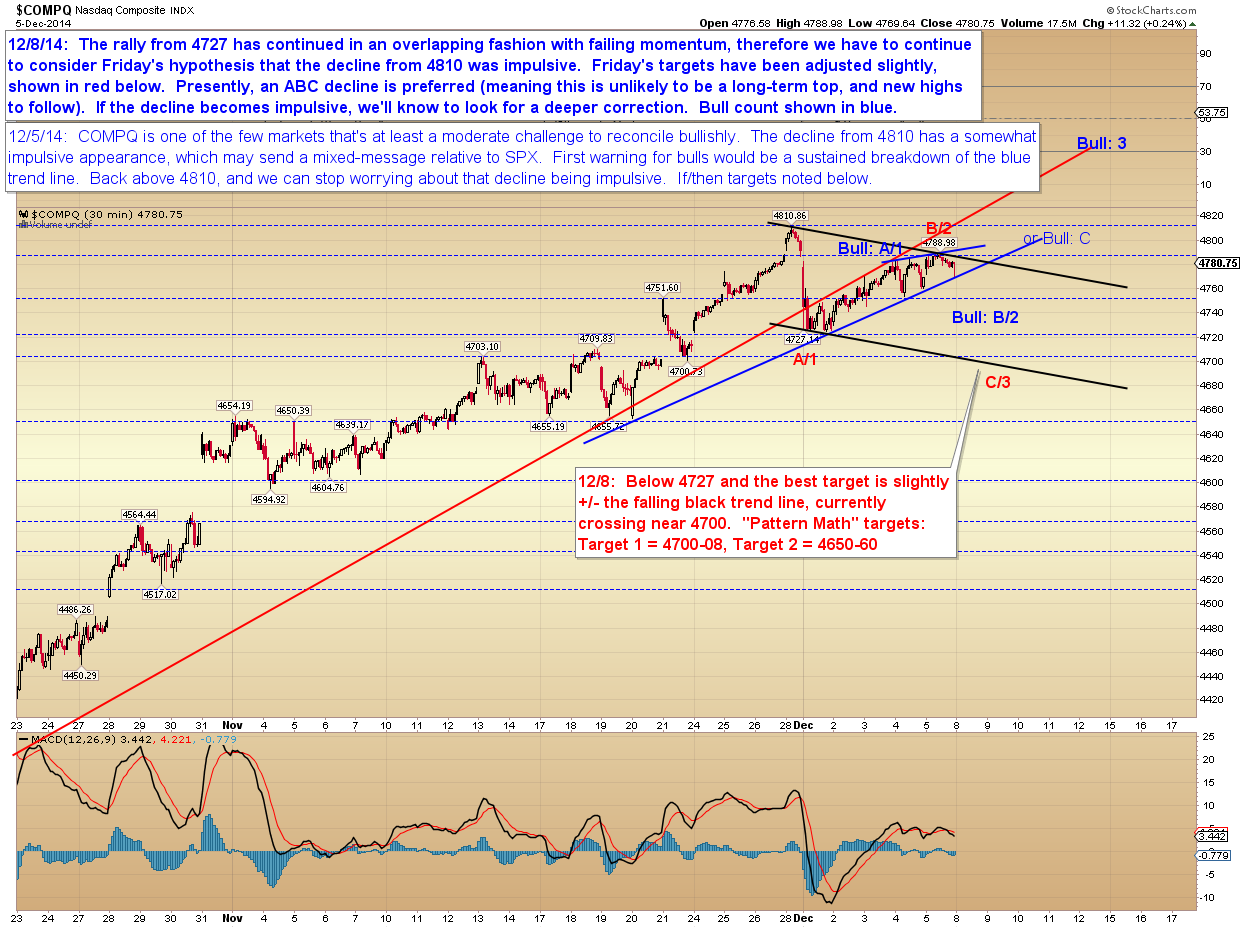
Friday's market didn't perform the way a third wave should, and this has left a number of complex options open. The charts might get a little confusing, so before we get into that, I'm going to give a brief synopsis of my thinking regarding the intermediate term:
1. RUT and NYA have, so far, failed to make new intermediate swing highs. Odds are good that needs to happen before a meaningful top becomes possible.
2. SPY has been up seven out of the past seven weeks. Over the past 18 years, this has happened seven times (go figure). In 100% of those prior cases, the market formed, at best, a minor correction before making new highs. In 0% of those prior cases, the market formed an immediate major top.
3. Last week, we looked at an RSI top study. Given the market's behavior in the past, it remains highly unlikely that any kind of final high is in place.
4. Therefore, while there is not yet enough pattern present to determine the exact depth of any (pending) near-term correction, I do believe it will simply be a correction, and resolve with new highs.
5. I currently believe the odds are good for an intermediate correction to follow after the next rally takes us to (presumed) new highs -- but let's not put the cart too far in front of the horse...
With that out of the way, let's see if I can keep the charts from being too confusing. We'll start with the simple news that BKX (one of several market I had noted) has finally broken its September swing high. We're still waiting on RUT and NYA to follow suit.
BKX near-term, best-guess:
In SPX, the pattern is so complex that I can spot three different options immediately -- and, due to the larger wave lacking a clear structure, there is no high-probability way to differentiate them.
I went 'round and 'round with myself as to how to present this chart in a manner that wouldn't be incredibly confusing, and I eventually settled on leaving the wave labels off for sake of clarity, and simply highlighting the potential target zones.
Finally, COMPQ remains the fly in the ointment here. I really want to view that decline as impulsive, yet it's difficult to reconcile COMPQ and SPX. There are two ways they could reconcile:
1. SPX was indeed an ending diagonal, and is aiming at the third target zone or beyond.
2. COMPQ's impulsive decline was wave C of a nearly-hidden flat and the blue bull count plays out.
In conclusion, the near-term is up for grabs. I only have a half-session-worth of decline to draw from, and the pattern leading into that decline is ambiguous at best, which makes it very difficult to draw a high-probability near-term target zone. Intermediate-term, while nothing's impossible, market history tells us that it's unlikely that the final highs are in yet. Trade safe.
Friday, December 5, 2014
SPX and COMPQ: SPX Validates Preferred Count; Here Are the Next Key Levels
On Wednesday, SPX validated the preferred count and made a new all-time high, good for a quick 23 points of profit. Bears are getting very restless with the seemingly-endless rally that's been underway since October. There are real fundamental concerns underpinning this restlessness: Oil is down 38% since June, the yen has continued to collapse, the dollar has continued to rally, and the economy has continued to be sluggish.
The issue, of course, is that we can't time the market using fundamentals -- all we can really do with fundamentals is frustrate and head-trip ourselves. Think about how well fundamentals have worked for timing since, say, 2009. Or think about how well they've worked during this rally. Are the fundamentals significantly different than they were a month ago? Not really.
Meanwhile, as we've examined here since October, the charts have yet to signal a meaningful top. The technical approach vs. fundamental approach is working just fine -- so, as always, everyone is advised to forget about whatever is making headlines in the current news cycle (barring a true black swan event, of course!).
I think it's important to ignore news, because news tends to bias our expectations. We hear something bad and say, "Oh, man, no WAY the market can rally with that going on!" And then when it rallies anyway, we start to feel like we're obviously smarter than the market, since (we think) we know why it "shouldn't" be rallying.
And at that point, things get dangerous for us as traders -- because we become emotionally attached to certain outcomes from the market. We become emotionally invested in those outcomes, partially because the realization of our hypothesized outcome would (ultimately, eventually, one day!) prove that we were, indeed, smarter than the stupid market. We were right all along! Back pats all around, and another round of government cheese for everyone! Because we're probably broke from being so darned smart that we fought the market tooth and nail the entire time it was going against us.
So forget about the news. To some degree, forget about the fundamentals, too. Let the charts tell you when the world is finally getting wise -- because they will tell you. Or they'll at least tell you that the possibility is there, if X and Y qualifiers are met. Maybe you won't hit the exact turn perfectly to the penny. So what? What's 20, 30, 40 points, relative to a major turn?
With that out of the way, let's look at the charts. First up is the SPX 30-minute chart. The option of a complex fourth wave remains on the table, but will not be considered further unless/until the market sustains trade below 2066. The alternate count shown here is for yesterday's high to have marked wave (v) of an ending diagonal (shown as black "alt: (5)), and this is another reason for longs to be cautious below 2066.
Next is the 5-minute SPX chart. Bear options begin to open up below 2066:
Finally, there is a fly in the ointment right now, and that's COMPQ. COMPQ's decline appears to be impulsive, and unlike SPX and INDU, it has not made a new high since then. This is one of the main reasons I'm continuing to give consideration to the possibility of a complex fourth wave in SPX, and also cannot eliminate the SPX alternate count from consideration.
In conclusion, trade below SPX 2066 does not guarantee a bearish resolution, but there is enough doubt across markets that such an occurrence would probably at least call for some near-term caution from bulls. Conversely, as long as 2066 holds, bulls are golden for the time being. Trade safe.
Wednesday, December 3, 2014
SPX, INDU, BKX: SPX Captures Targets, INDU Validates Preferred Count -- What Next?
Last update expected that the decline would prove to be corrective -- and by Tuesday, INDU had already made a new all-time-high, which validated the preferred count in that index.
SPX did not make a new all-time high, but did capture its preferred 2047-53 target zone, and subsequently generated a 19-point bounce. No matter what happens from here, it's hard to complain about that outcome.
The question now is whether ALL OF wave (4) is complete. Fourth waves are known for their complexity and unpredictability, so we have to stay alert to the possibility of a complex fourth. This is best illustrated via INDU, as an immediate reversal lower from here would strongly suggest an expanded flat. I'm going to keep the complex fourth as the alternate count for now, but this is a bit like saying, "I prefer the next roulette spin to land on black," since there's no law or rule that grants a simple fourth wave a serious edge over a more complex wave.
The upshot is that if there is another wave down immediately, then it will likely be a high-probability long play, because Monday/Tuesday's rally doesn't count well as a complete impulse just yet.
The main reason I'm preferring the roulette wheel to land on black for INDU is BKX. BKX has overlapped its wave A low, and that means two things:
1. It's probably an ABC decline.
2. In the event it's not, then another wave down here could be very technically damaging. Which doesn't really fit INDU's pattern for another wave down. I suppose it's always possible for BKX to collapse as INDU is making new highs, but that seems rather unlikely.
I have to mention that because BKX has not yet overlapped the first wave in its current decline, there is still the potential for a marginal new low here -- it's just hard to see that happening with this current pattern.
And thus we come to SPX, which, as noted, captured its preferred target zone dead-center and rallied. In fact, all I really had to do to complete this chart was move the c/(4) label about an eighth of an inch to the right (or 3.1750 mm, for our European readers) Of course, accuracy of targets does not guarantee that the fourth wave thesis was correct, because I use a variety of tools to arrive at targets -- but it should at least have guaranteed a profit for nimble traders either way.
Due to the nature of fourth waves, and the lingering alternate count, I've noted the next potential targets in the event 2049 fails.
The main thing bothering me for equities at this juncture is that oil has fallen so far, so quickly. This impacts some of the largest individual components of the major indices (such as Exxon and Chevron), and further impacts the banks who service those companies. This can have a bit of a domino effect, and it remains to be seen if the price of oil will stabilize. Interestingly, this could ultimately become one of the catalysts for the thesis I put forth in October that the current rally is a high-degree fifth wave, with a significant correction to follow.
Be that as it may, the charts still suggest we probably haven't seen an intermediate-term top just yet -- but they also suggest we may finally be getting close, at least in terms of price. In a perfect world, I'd still like to see BKX, RUT, and NYA make new highs before it's all said and done, in order to complete fifth waves across the board. In the meantime, in the event the market has more tricks up its sleeve, the first step for bears directly from here would be a breakdown at 2049 SPX. Trade safe.
Monday, December 1, 2014
SPX, RUT, INDU: Bears Want to Know if We're There Yet, Bulls Want to Know if "Santa Rally" Will Appear in the Title
Let me start off by saying that I hope everyone had a good holiday weekend! I apologize for the title's verbosity, but I was required by the Stock Market Writers Guild to put the term "Santa Rally" into the first title of a December article. I don't pay those annual Guild dues for nothing!
Last update again called attention to the 2075 target from October, and SPX finally reached that price point... and reversed. Bears want to know if this is it, so let's take a look at the evidence. We'll start with a long-term daily chart of SPX:
I know this isn't what bears want to hear, but RSI history suggests this probably isn't the final top -- however, some backing and filling from this zone would be quite reasonable.
On the 30-minute SPX chart, I've adjusted the speculative wave count again. I realize that I was previously looking for a top in the 2075 zone, and it appears we'll indeed get one -- but after studying all the available evidence (not shown, read: 50,000 other charts), I presently have some doubts as to 2075 being THE top. That could always change as the structure develops, but a fourth wave looks like the more likely culprit at the moment.
Next up is a look at RUT, which probably still needs a new high to be complete. This could suggest the fabled Santa Rally, which (and try to follow along here) the market has had every single year, except for the years it hasn't.
Next is INDU's daily chart, which I annotated so many hours ago that I no longer have any idea what it says. Let's upload it and find out..!
Awesome, it looks like it agrees with these other charts.
INDU's 5-minute chart notes a couple potential near-term targets (continued, next page):
Subscribe to:
Comments (Atom)